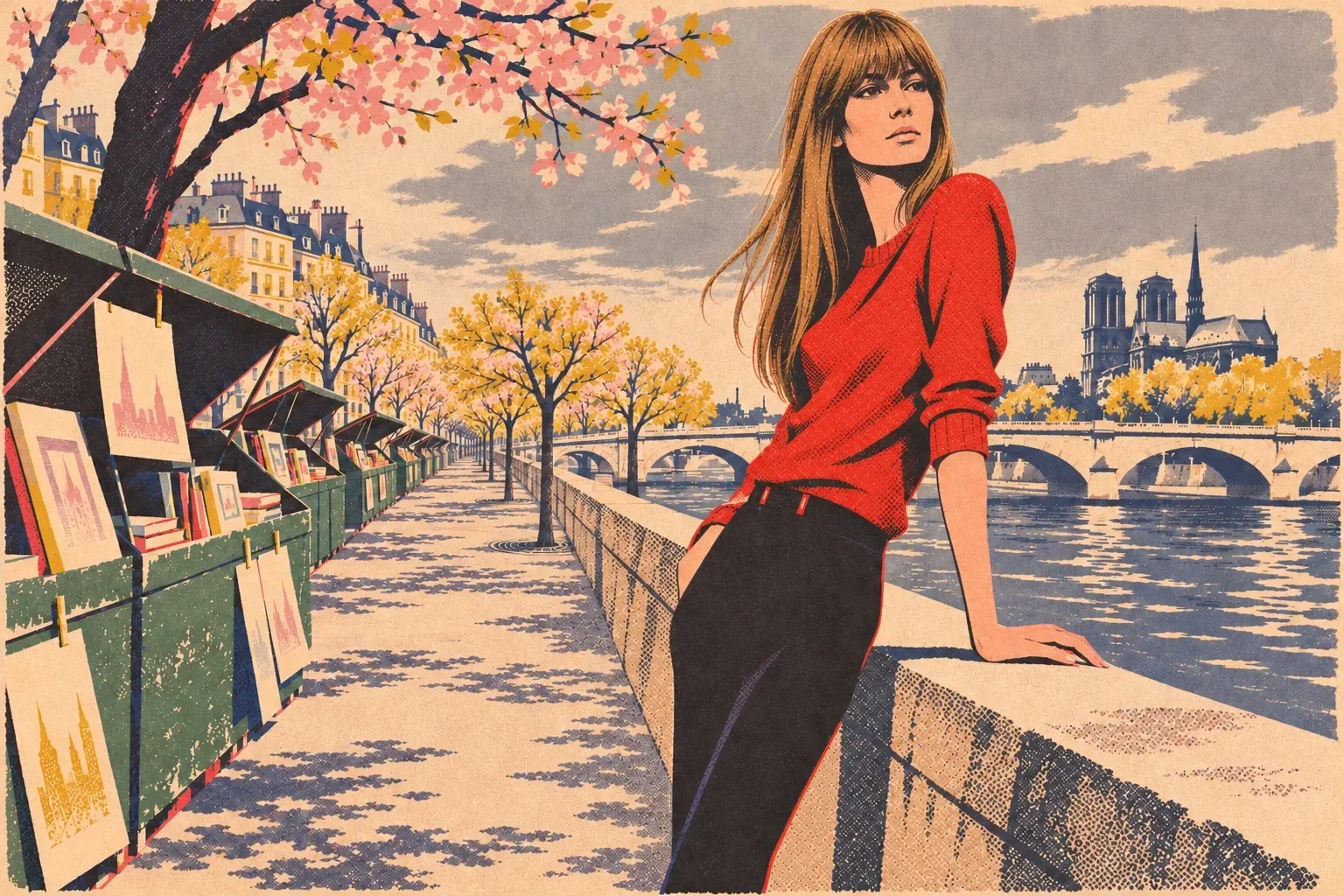
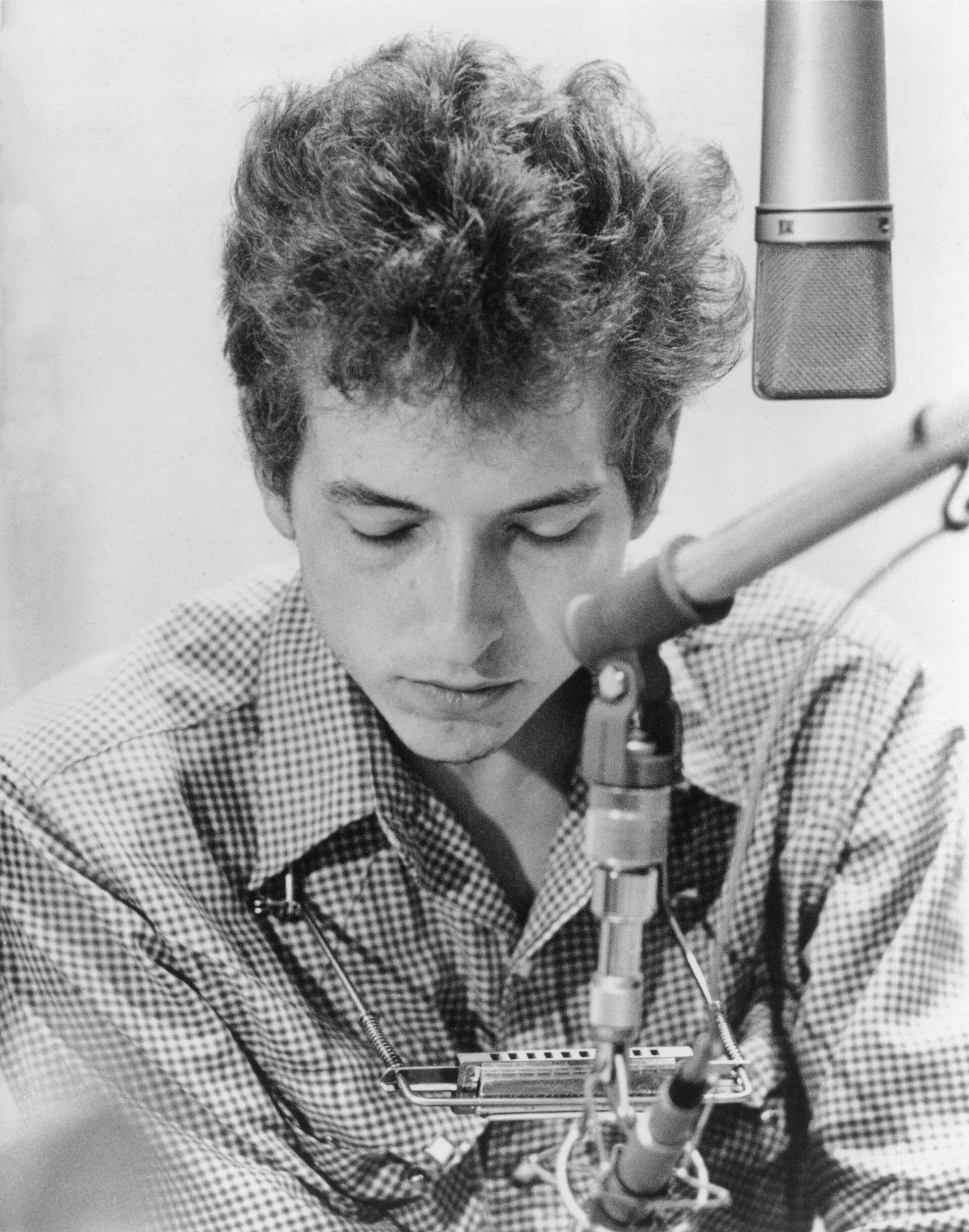
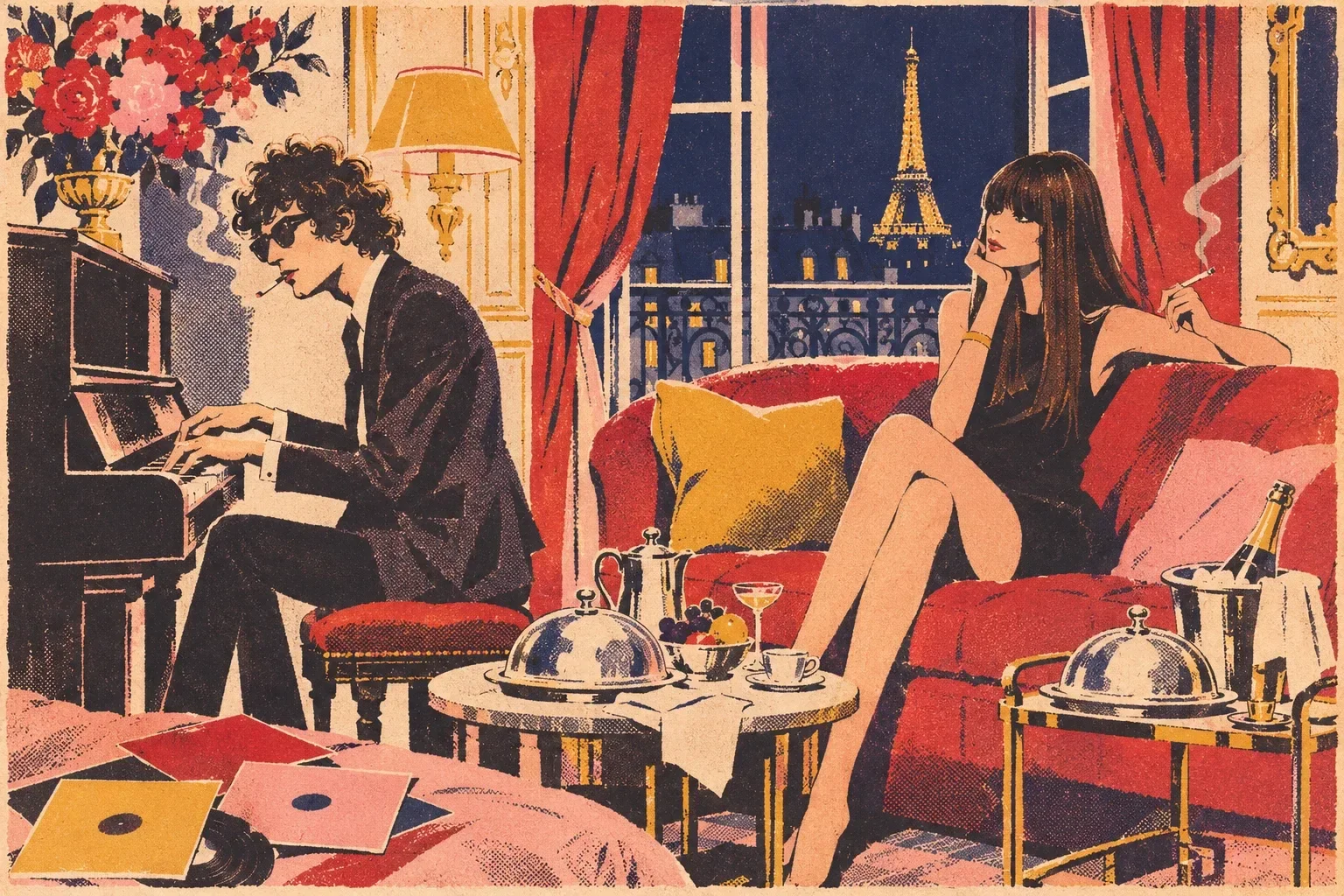
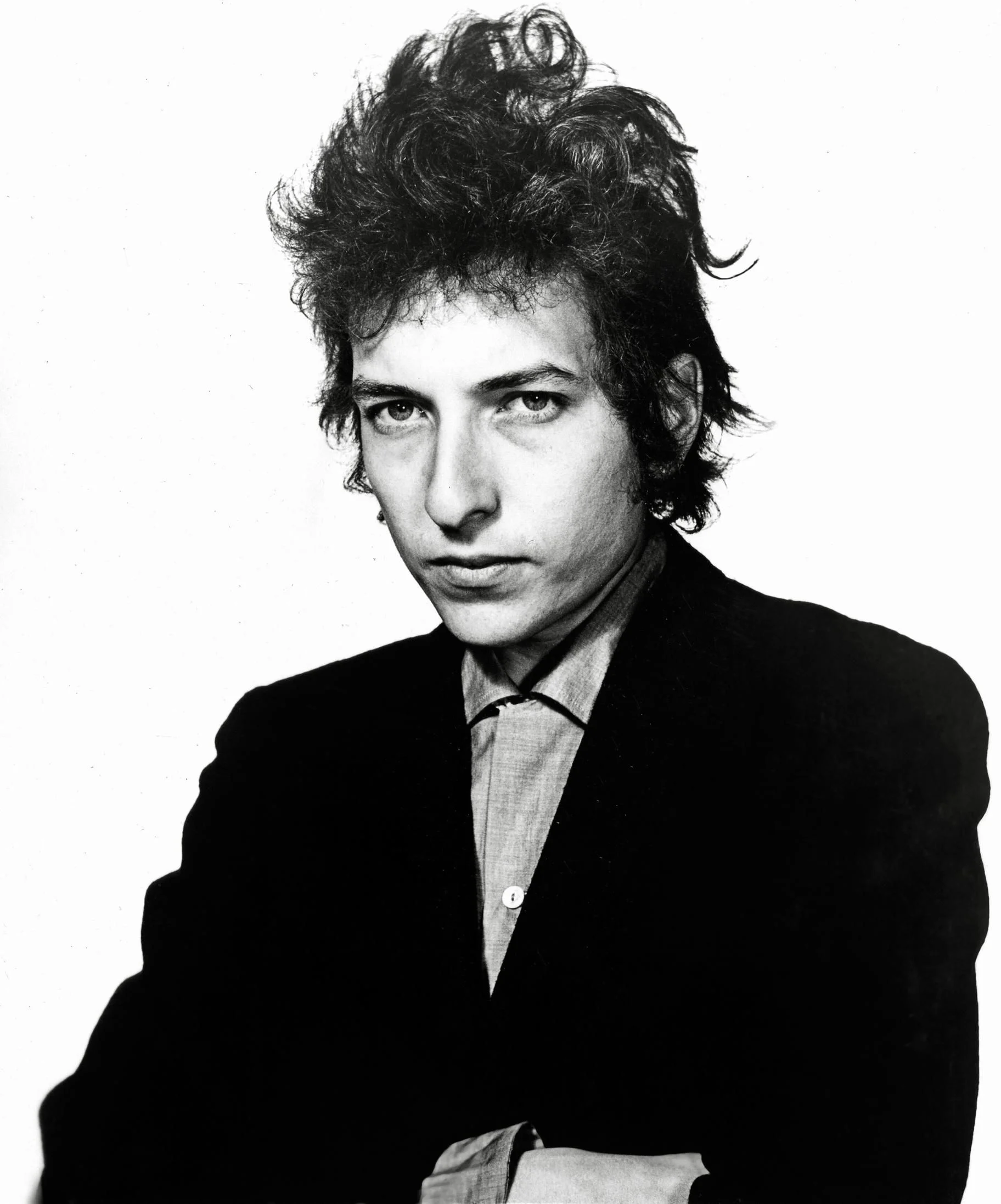
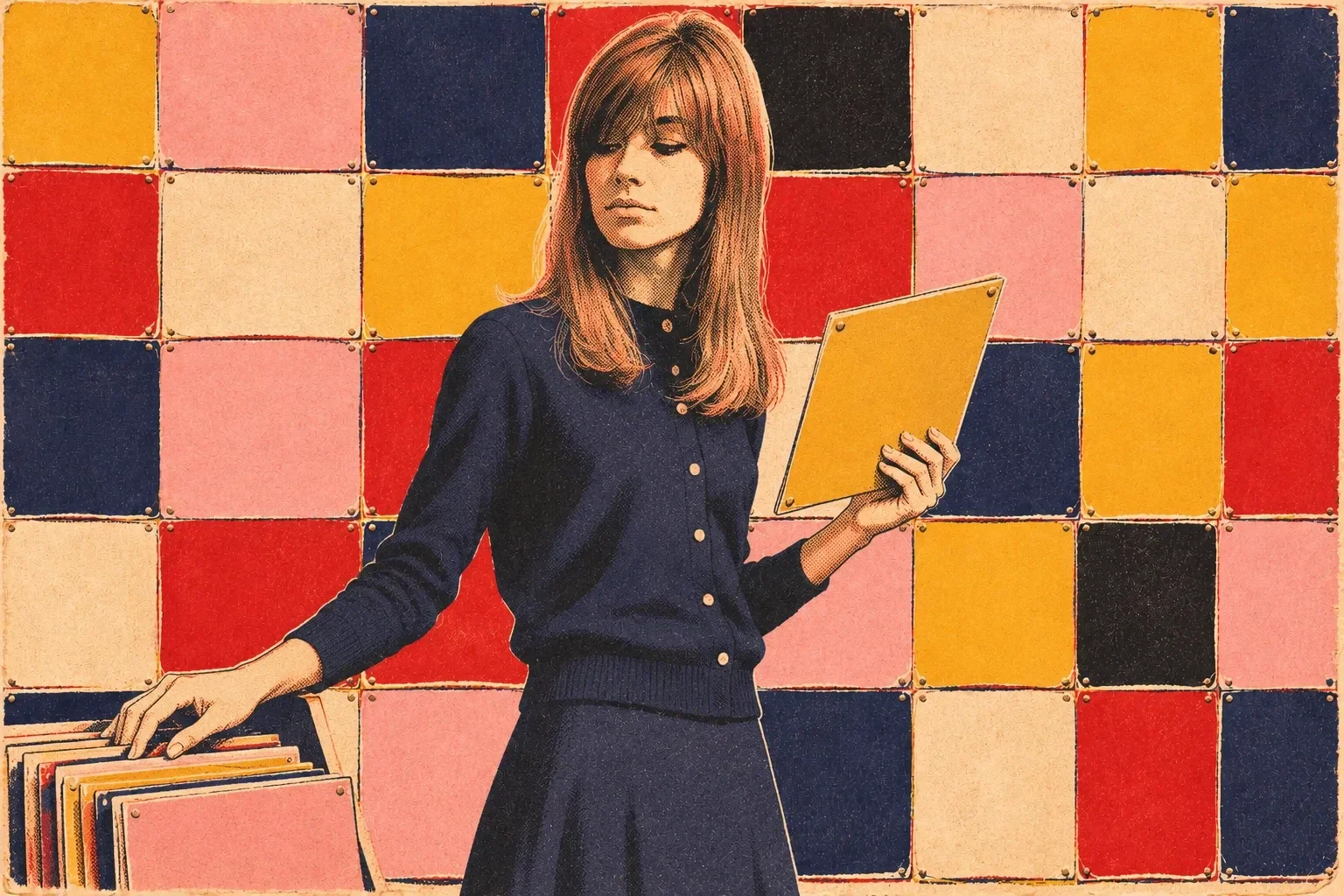
The girl Bob Dylan stopped his concert to meet. Françoise Hardy, yé-yé, her songs, her dresses, and one night in Paris in May 1966
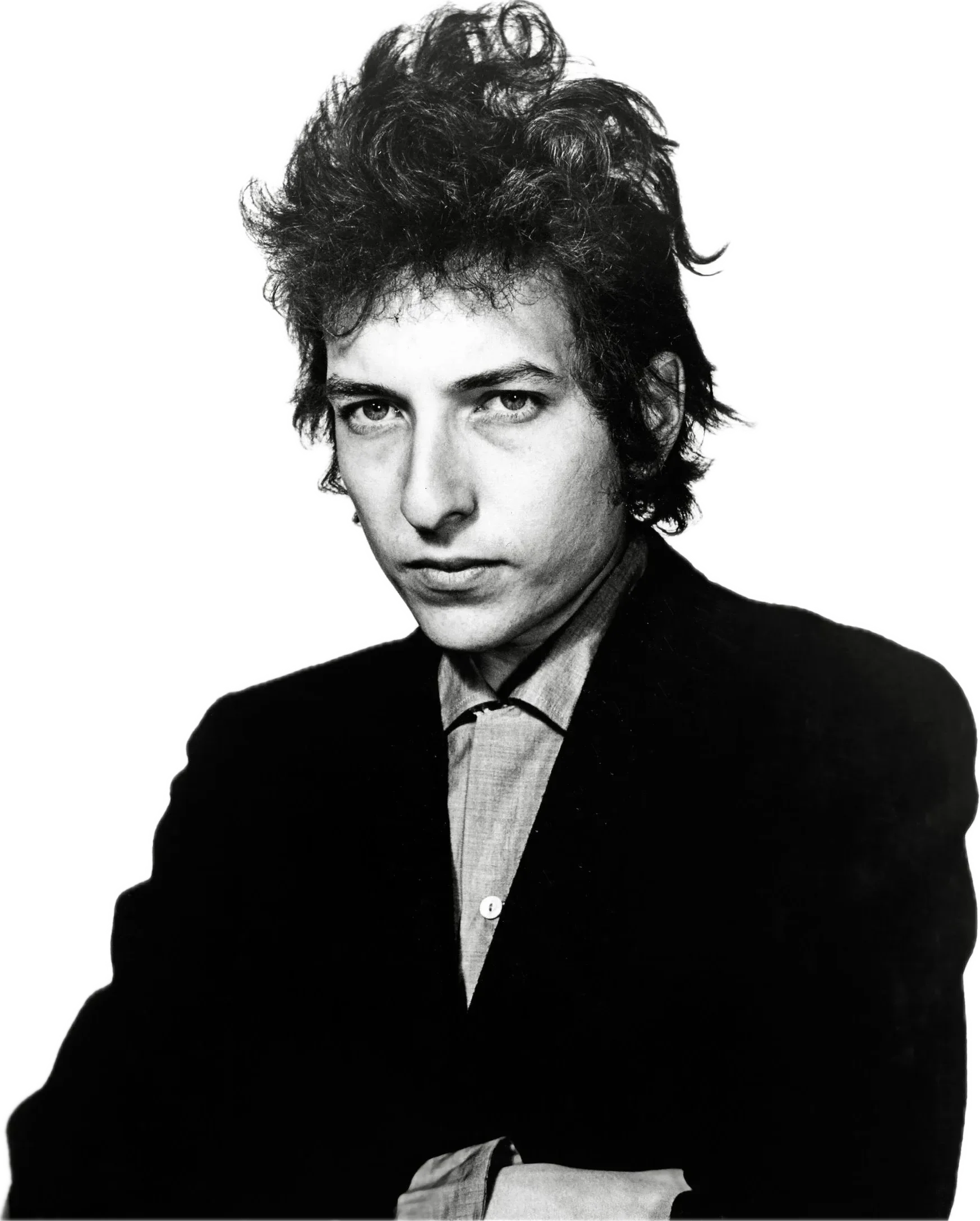
I'm not going back out there till Françoise Hardy comes to see me.dylan
Moi ? Mais… je parle à peine anglais.hardy
Just listen. It's called “Just Like a Woman”.dylan
C'est très beau… je crois.hardy
01
Chapter One
The Intermission That Would Not End
OLYMPIA
Bruno Coquatrix présente
BOB DYLAN
mardi 24 mai 1966
1re partie : seul à la guitare · 2e partie : avec ses musiciens
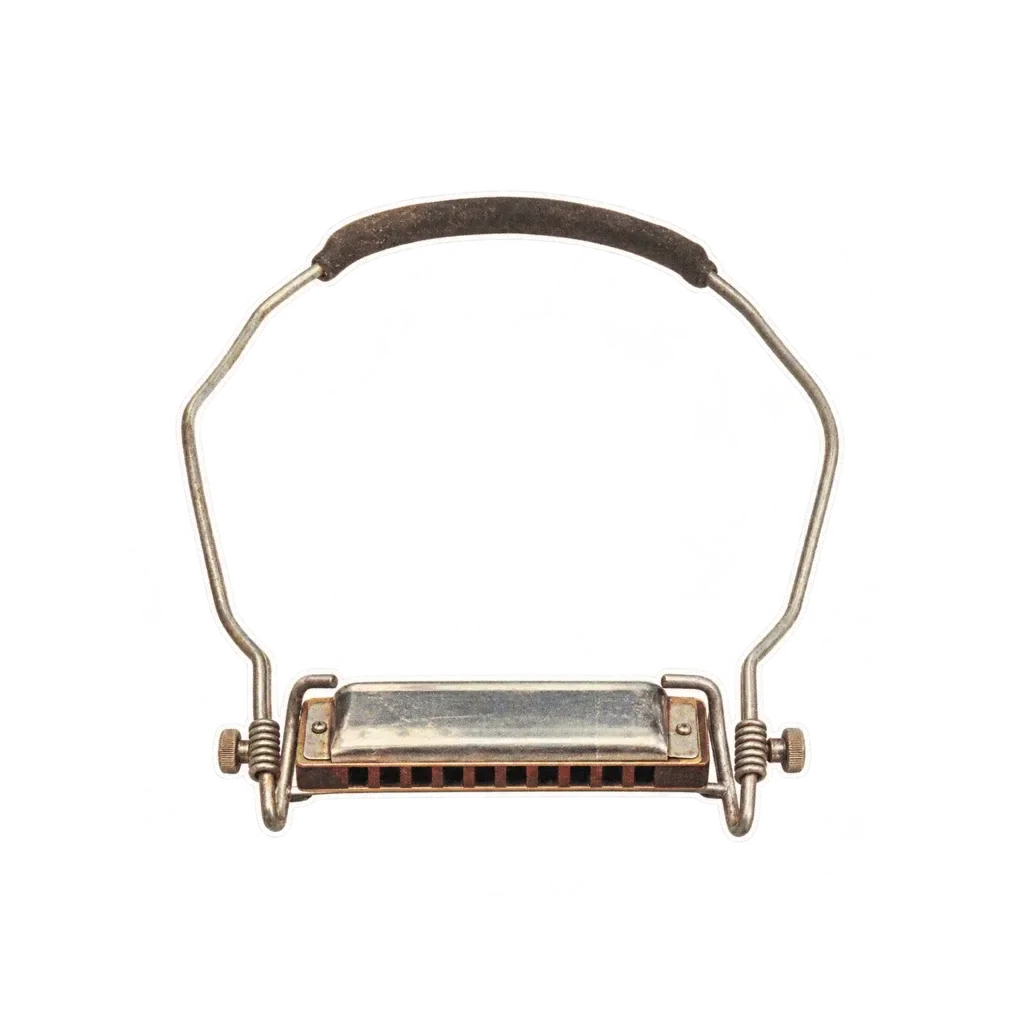
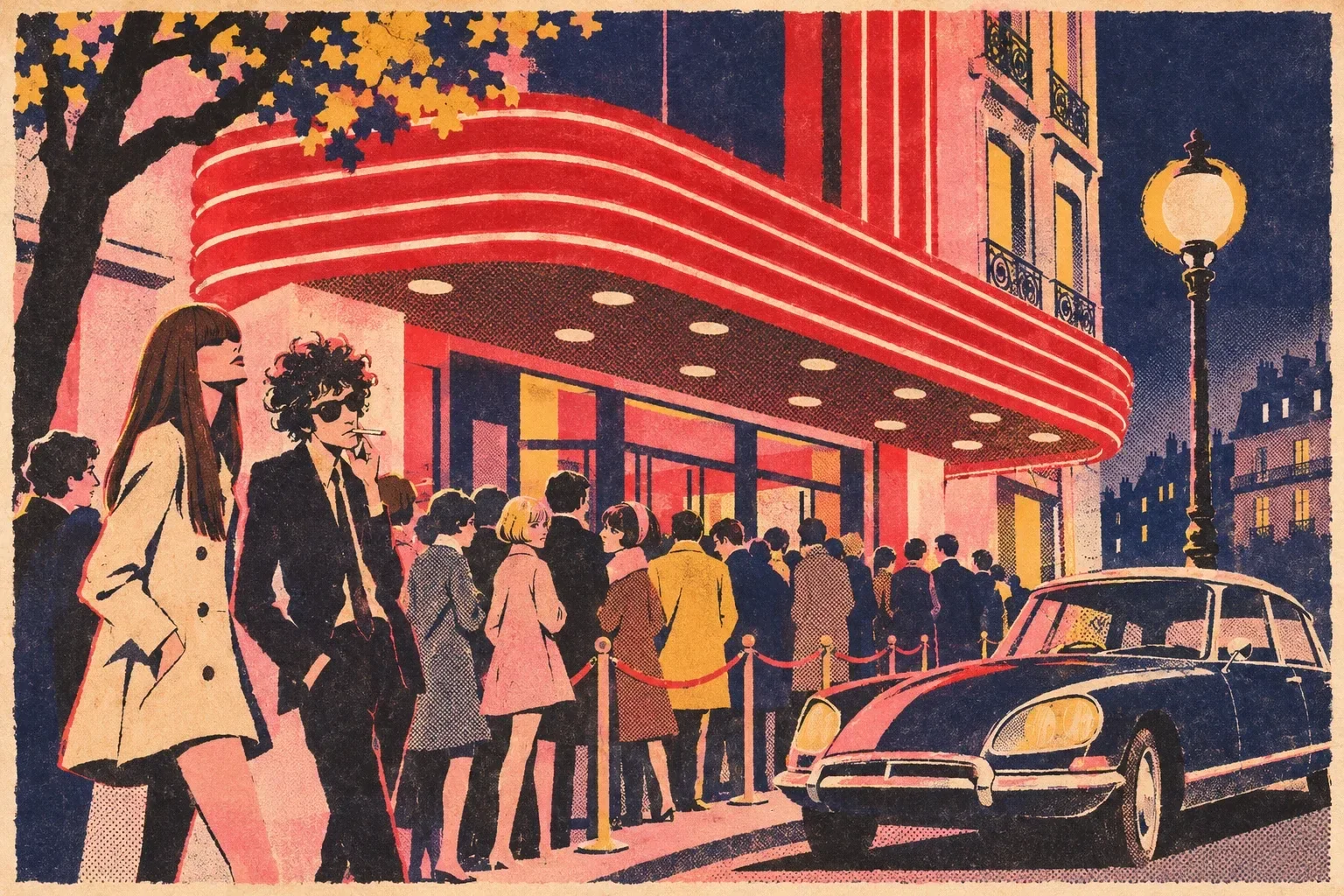
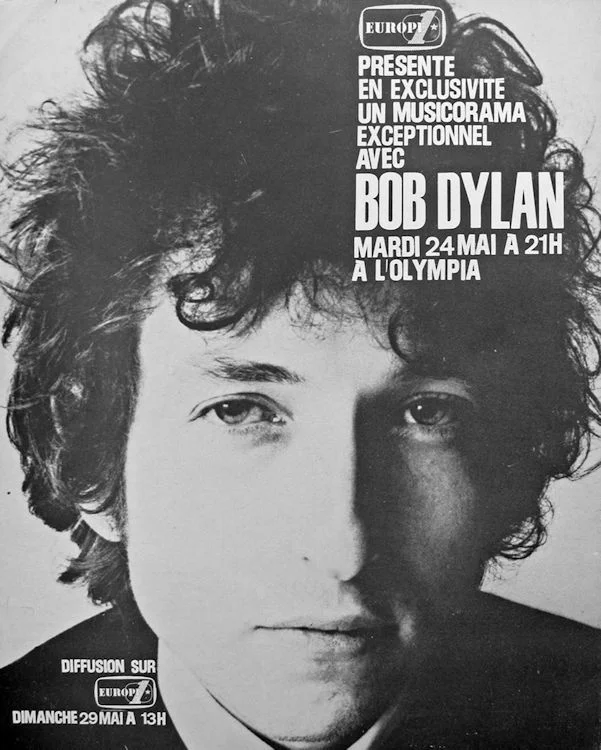
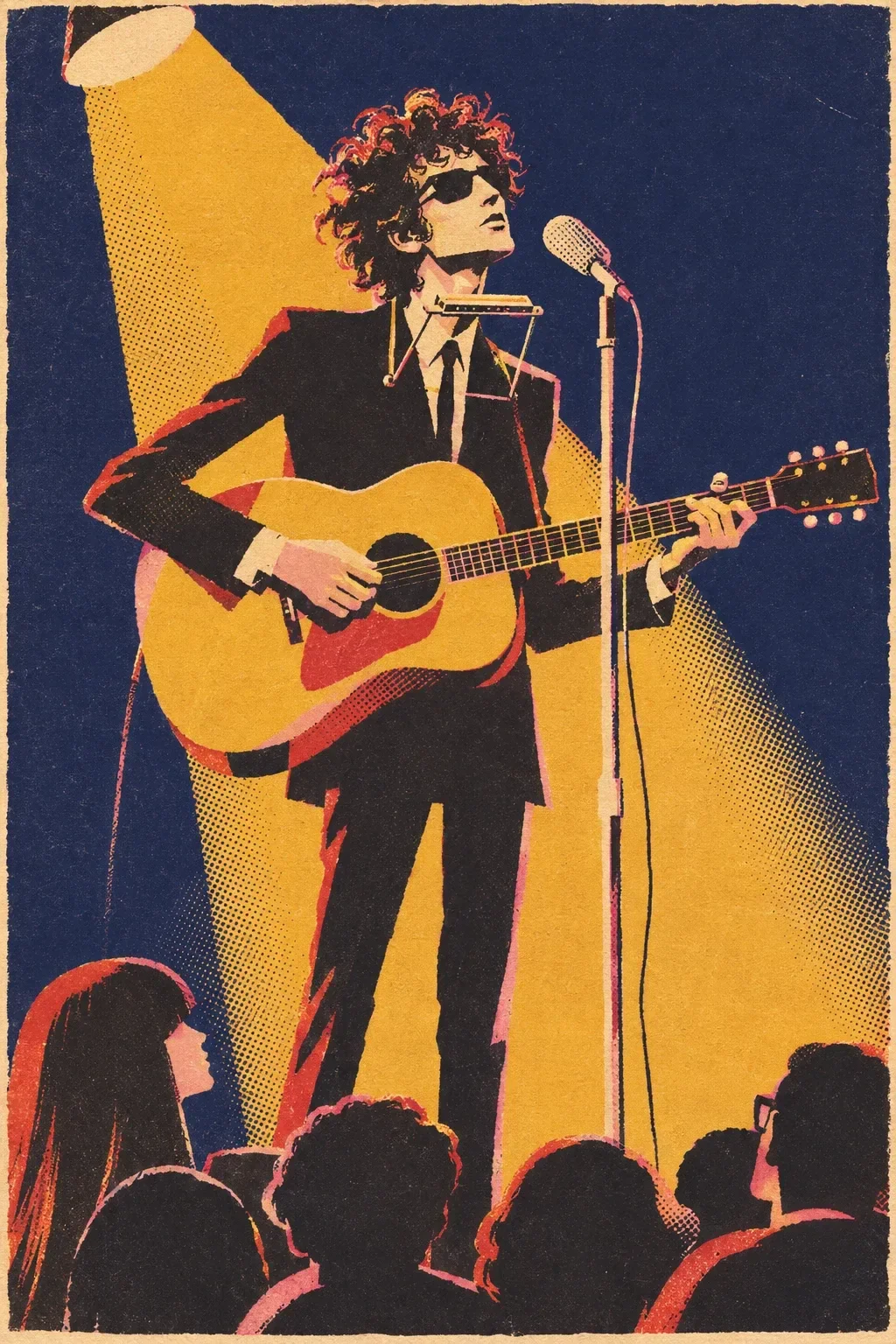
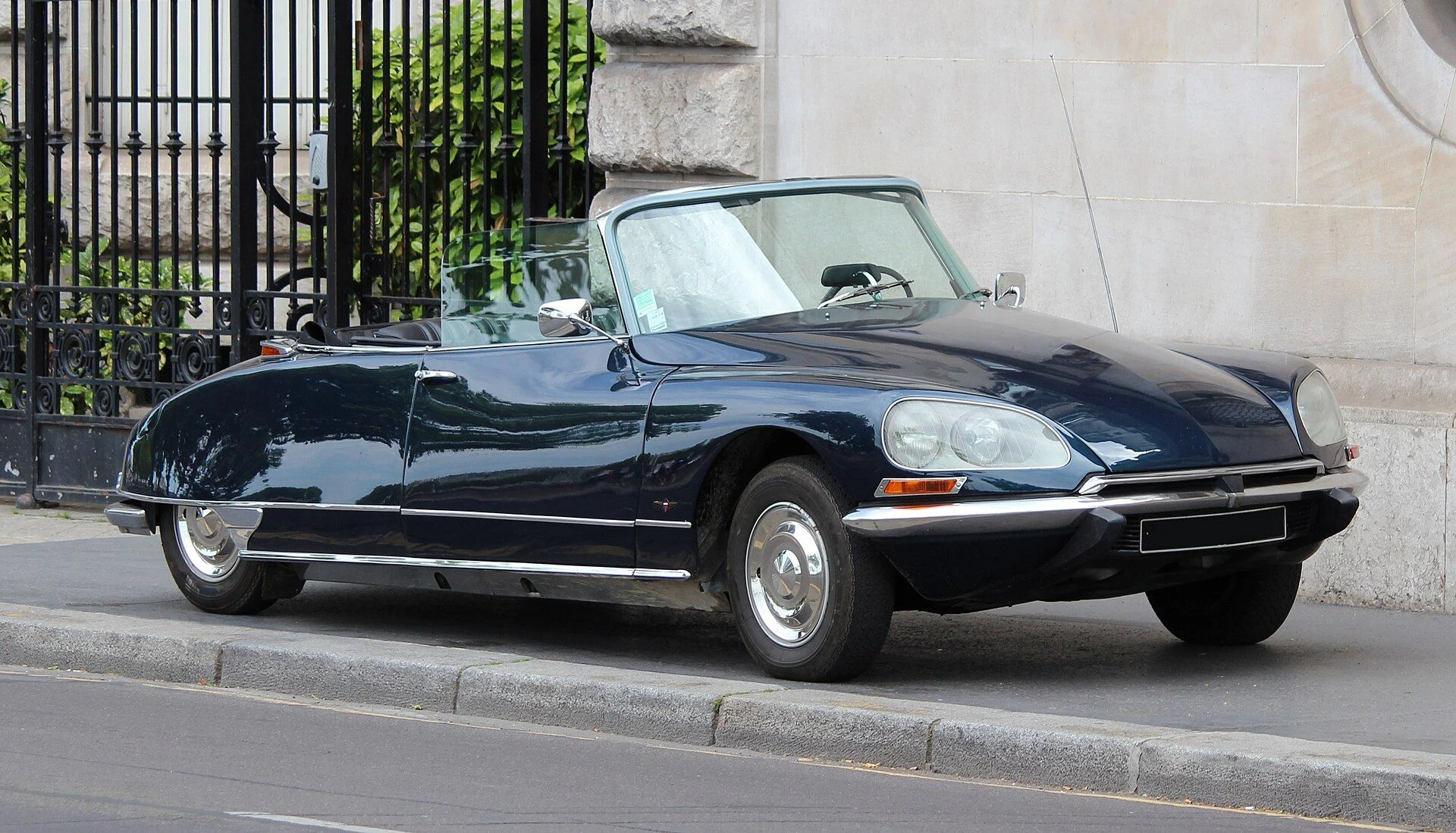
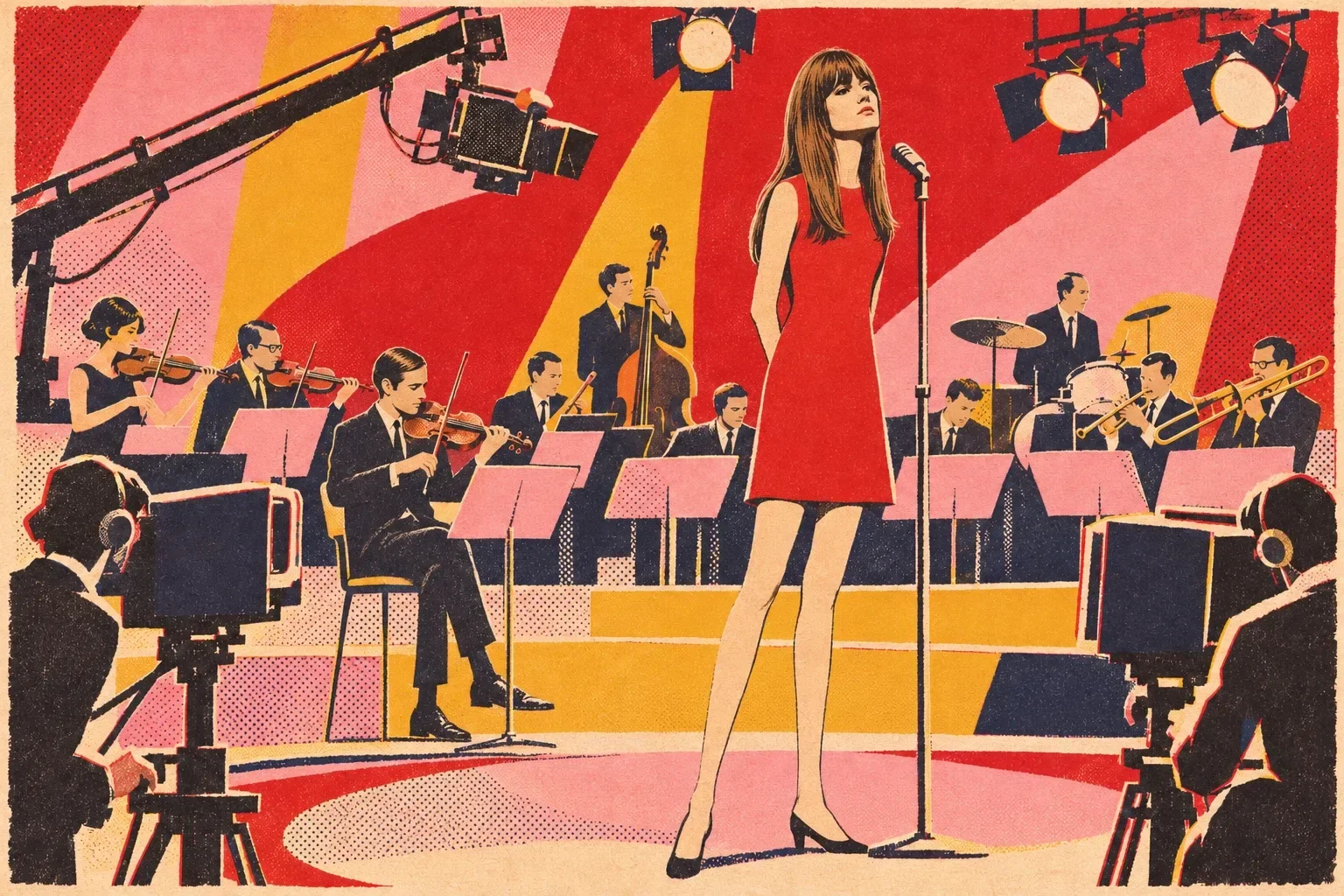
On 24 May 1966, Bob Dylan turned twenty-five. He spent the evening of his birthday onstage at the Olympia music hall on the Boulevard des Capucines in Paris, where Édith Piaf had sung. It was one of the hardest tours of his life. For the first half he played alone, with an acoustic guitar and a harmonica, as he always had. For the second, he came out with an electric band, and all over Europe this was the moment when audiences began to whistle, stamp their feet and shout “traitor”. Paris was no exception.
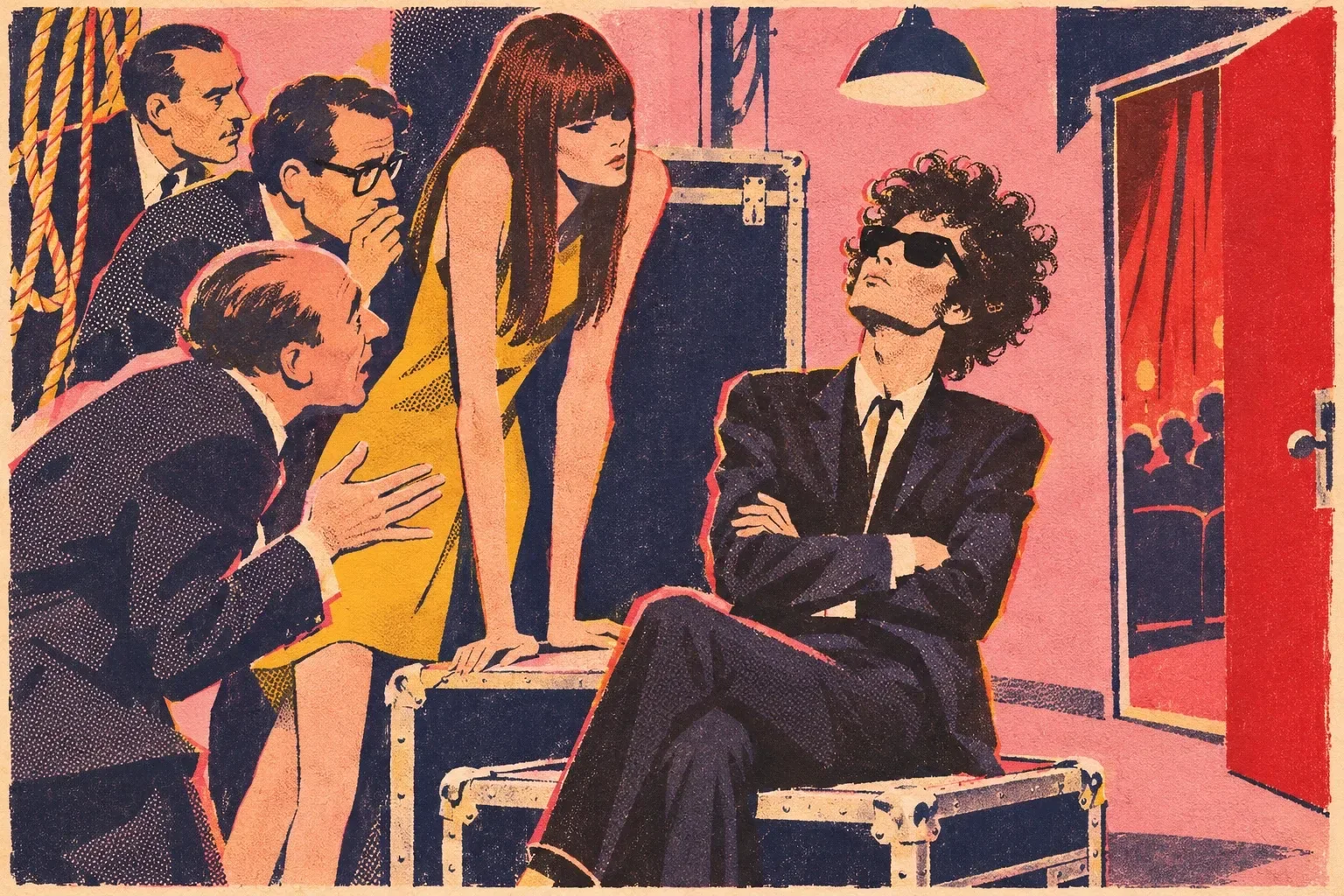
During the interval, something went wrong backstage. The intermission dragged on. The audience waited. Then someone approached a young woman in the crowd with a message: Dylan would not return to the stage until she came to see him.
She was twenty-two. Her name was Françoise Hardy, and everyone in France knew who she was.
That is how Hardy herself told the story, both in her 2008 memoir, Le Désespoir des singes… et autres bagatelles, and later in a 2018 interview with The New York Times. A similar account had appeared as early as 2004 in a book about Dylan cited by Le Monde. Whether she heard the ultimatum from Dylan himself is unknown: someone relayed it to her. But she went.
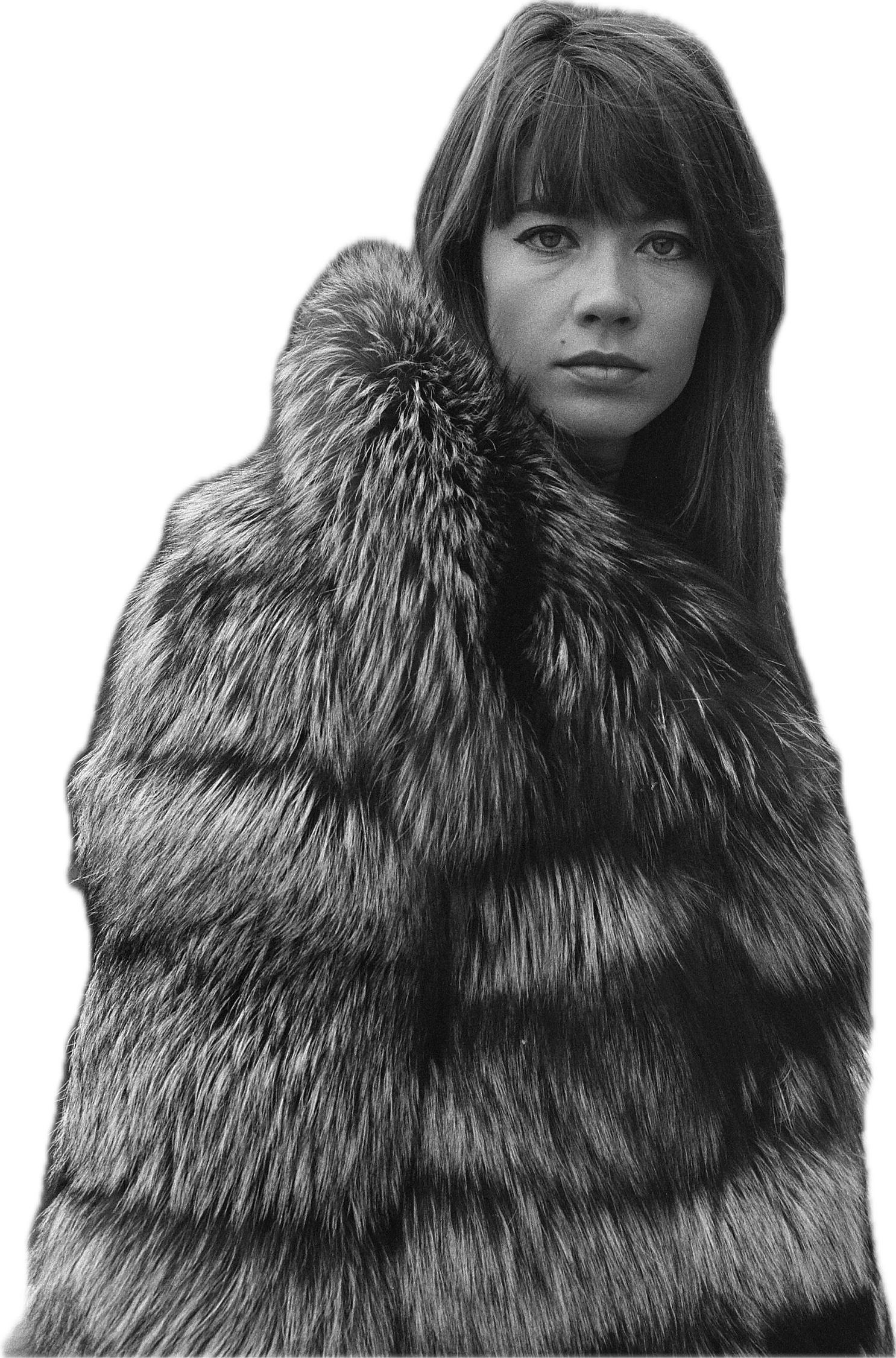
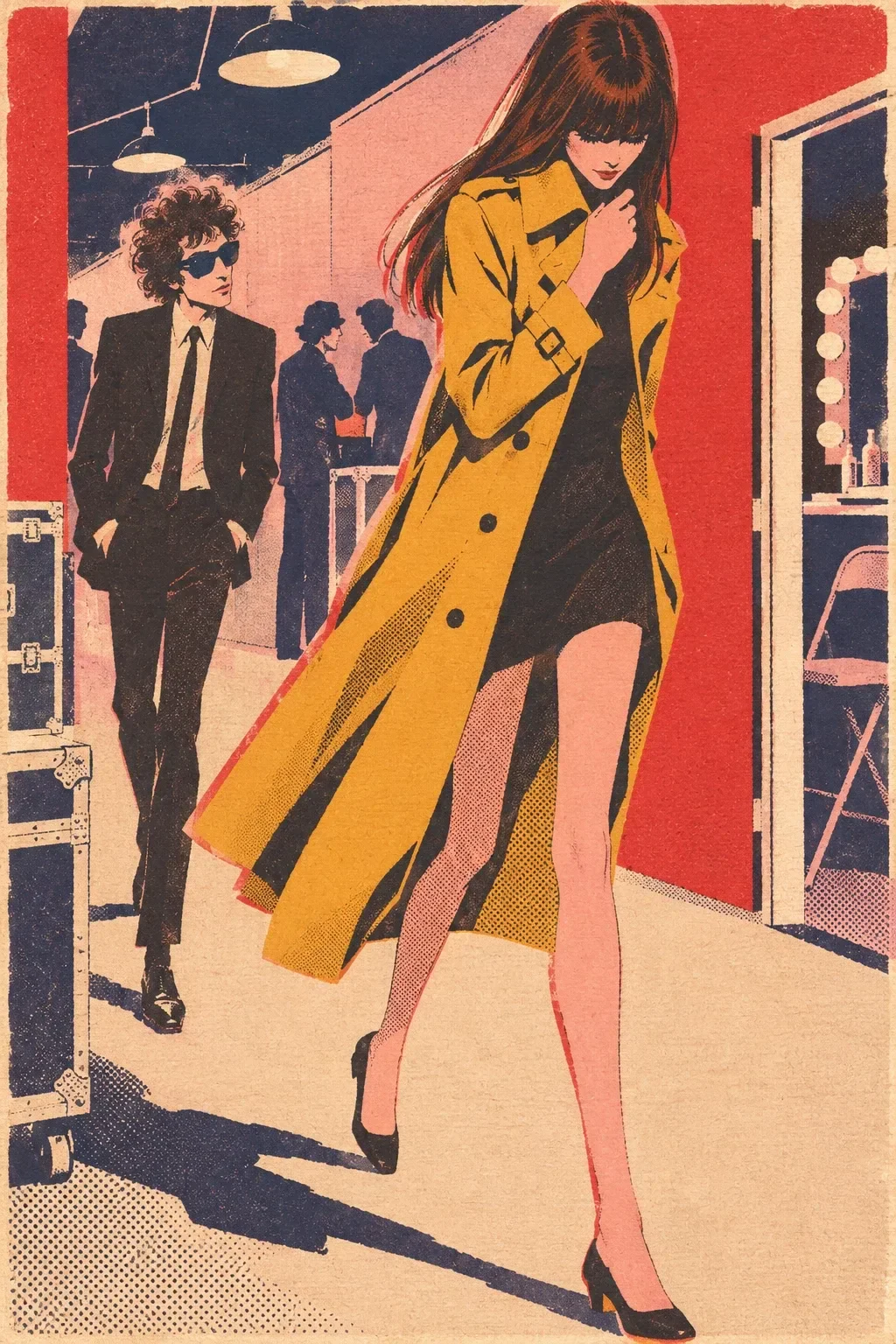
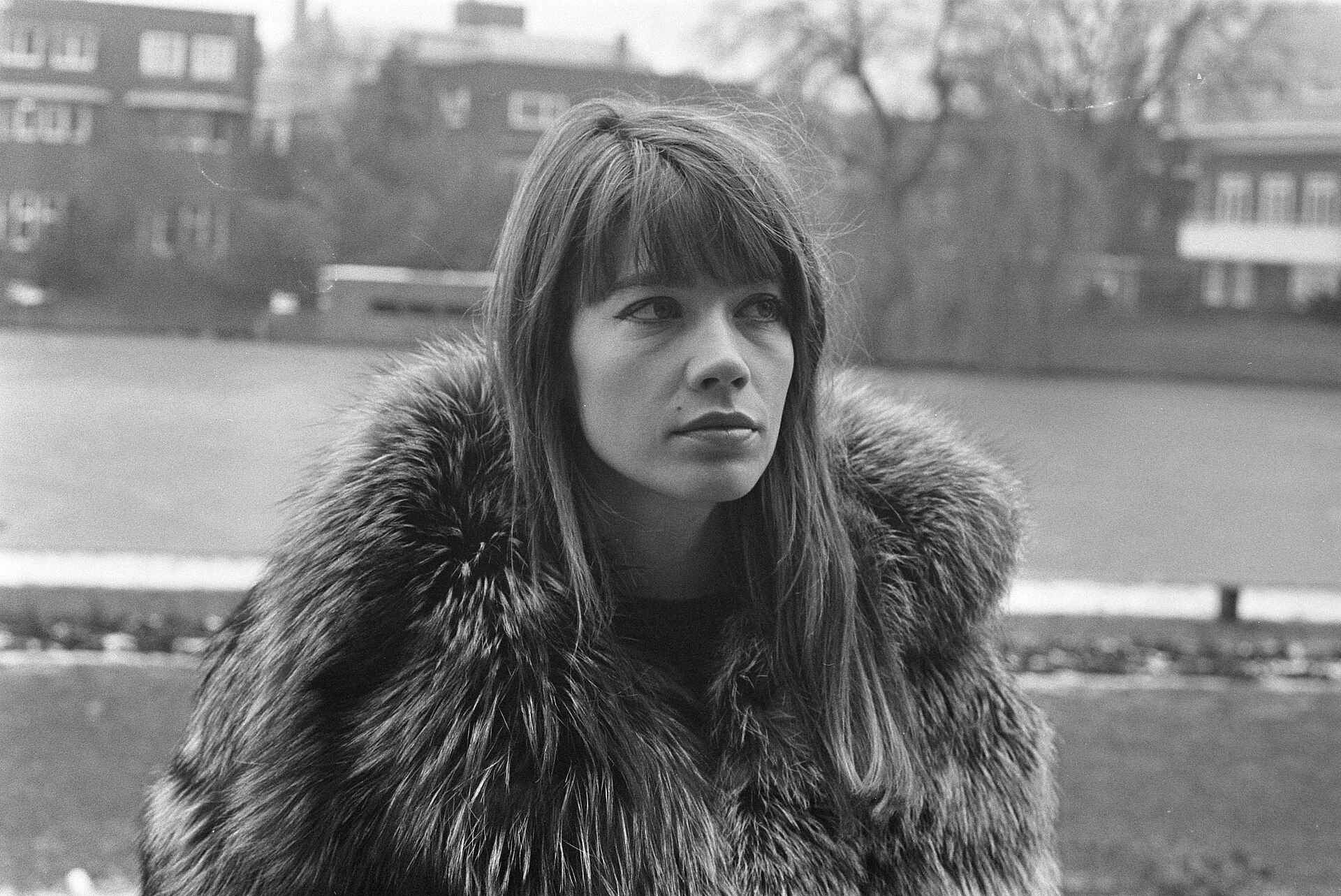
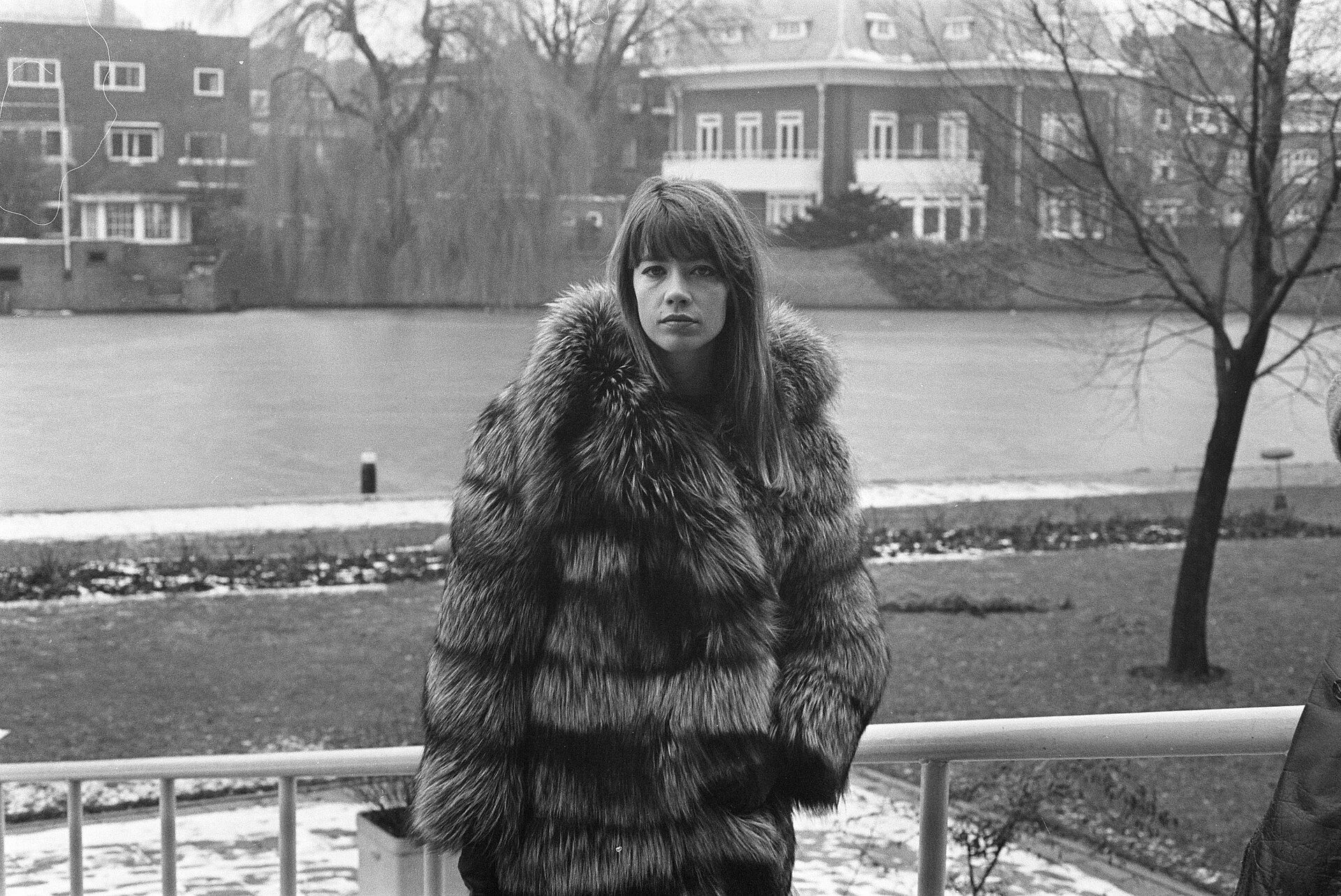
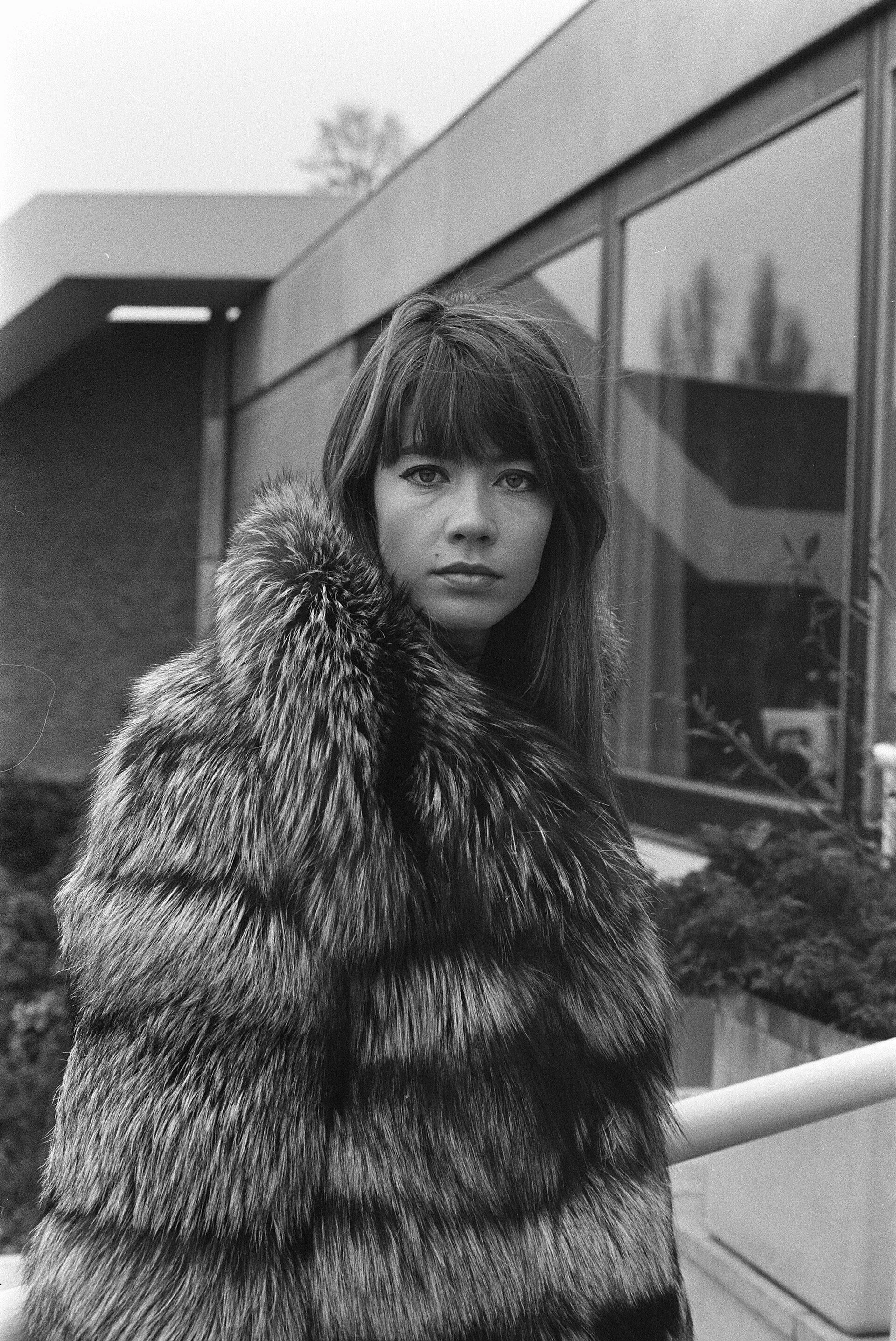
Tall and slender, with long, straight hair and a heavy fringe, she walked down the backstage corridor with her eyes on the floor. She was painfully shy—so shy that two years later she would give up live performance altogether. Dylan saw her. And went back to his audience.
02
Chapter Two
“At the Seine’s Edge”
To understand why Dylan was so determined to see her, we have to go back two years. In August 1964, he released his fourth album, Another Side of Bob Dylan. On the back of the sleeve, in small print, were his poems: a long sequence of free verse without capital letters. One began “for françoise hardy / at the seine's edge”. What followed was Paris as imagined by someone who had never been there: Notre-Dame, students, bicycles, lovers, the river.
They had never met. Hardy later explained that Dylan had developed, in her words, a “romantic fixation on a photo of me”. By 1964, her face was on record sleeves and magazine covers across Europe, and one of those photographs seems to have been where it all began.
For years, a story persisted that they had met earlier, in London in 1964 or 1965, where both were recording and performing. There is no evidence for it, and in 2018 Hardy explicitly named Paris as the place of their first meeting. The London encounter is one of those stories that is tempting to tell, but better left untold.
03
Chapter Three
A Night at the George V
After the concert, Hardy found herself at the Hôtel George V, a short walk from the Champs-Élysées, where Dylan was staying. He had held a press conference there the day before. Now his room was crowded with guests. Then Dylan asked her to come over—alone—to hear two new songs. Blonde on Blonde had not yet been released. The songs were Just Like a Woman and I Want You.
Whether he played them on his guitar or put on the new studio recordings depends on whose account you read. The Independent wrote of a guitar; Spain’s El País said he let her hear them. We can put it cautiously: that night, Françoise Hardy was among the first people in the world to hear two songs the whole world would later know by heart.
And she understood almost nothing. Her English was what she had learnt at school; she caught the meaning in fragments. As for conversation, there was none.
That was the whole scene: two desperately shy people in a noisy room, one speaking no French, the other barely any English, and two songs between them. Journalists imagined the rest. Hardy’s own recollection was far from happy. In 2001, she recalled that “il était en très mauvais état”—he was in a very bad way: terribly thin, strung out, at the end of his tether. This was the tour after which he would crash his motorcycle and disappear from public view for years. She did not say exactly what was wrong with him, and we will not speculate.
There was no affair. In 2005, she told a British newspaper—or so a Spanish translation reported her words—that Dylan interested her as an artist, not as a man. And it seems they never met again. In one interview she said she had met him only once, in Paris in 1966.
The story has a curious epilogue. In 2018, Hardy told the German magazine Zeit that she had recently received two drafts of letters from Dylan—love letters that had never been sent. “He must have been very much in love with me,” she said. Where those pages came from, and what was in them, could not be verified. In any case, there was no correspondence between them.
One thing there certainly was not: Hardy singing Dylan’s songs. She covered Leonard Cohen, Phil Ochs, Neil Young, and Brassens’s settings of Aragon’s poetry. Dylan, never—at least on any released record. He wrote poems for her. She came to see him during an intermission. That is where their story ends.
Why did everyone in France know a twenty-two-year-old woman in 1966? To answer that, we need to talk about yé-yé.
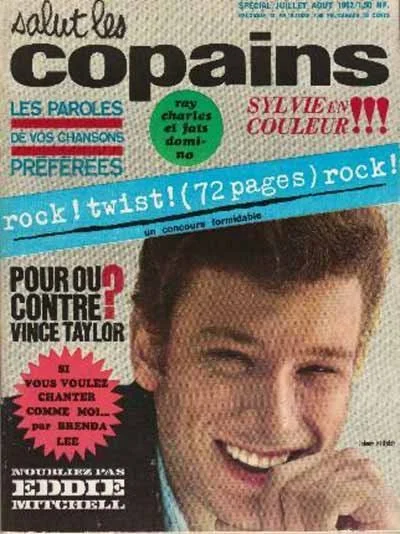
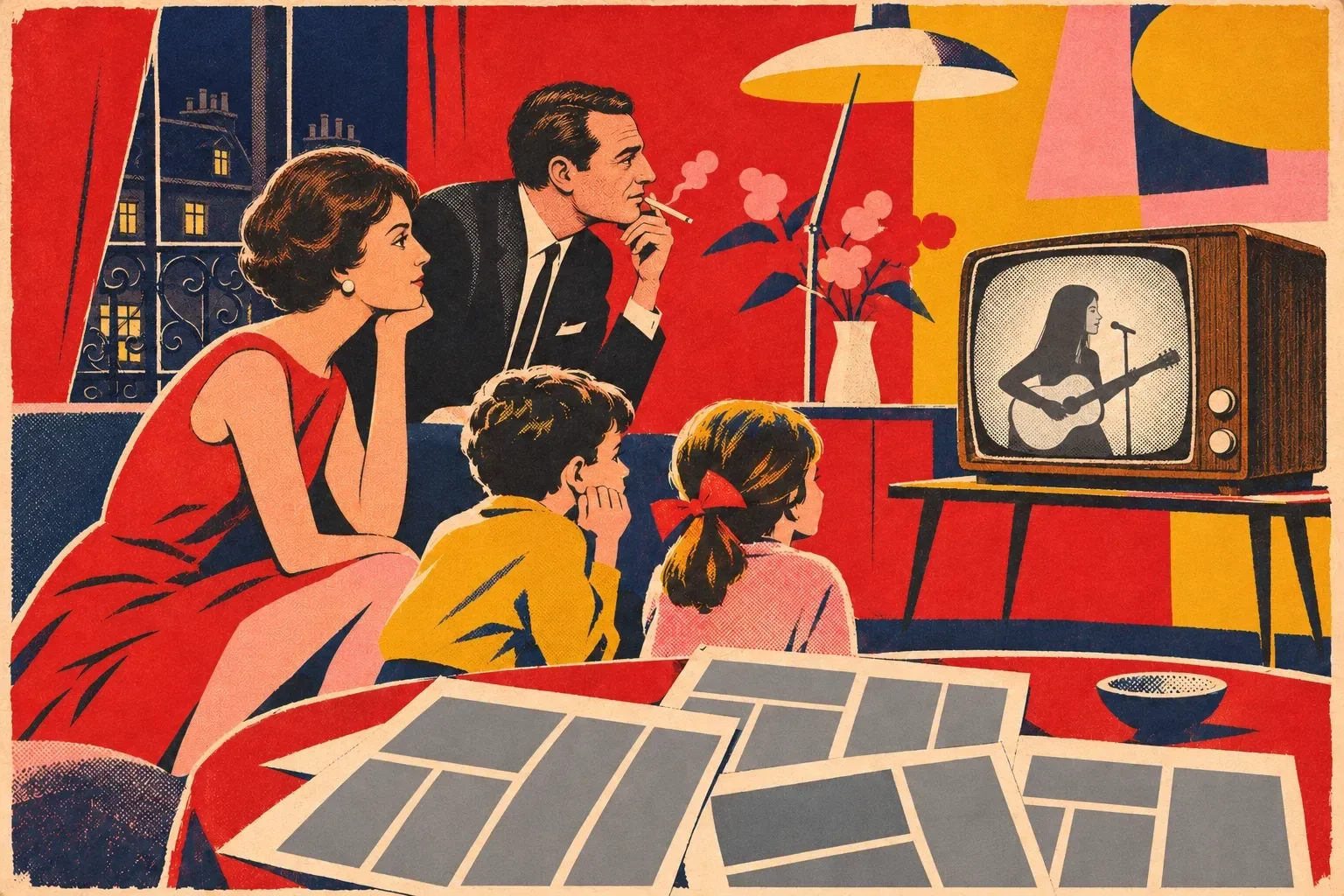
On 19 October 1959, the radio station Europe 1 launched Salut les copains—“Hello, friends”. It was devised by two jazz enthusiasts, Daniel Filipacchi and Frank Ténot. Every day after school, French teenagers dropped their satchels, switched on their transistor radios and listened to rock ’n’ roll, the twist and new songs by people their own age. In the summer of 1962, the programme acquired a monthly magazine of the same name, with Johnny Hallyday on the first cover. It sold as no youth magazine had sold before. Disco Revue had appeared earlier, in 1961, while television had Albert Raisner’s Âge tendre et tête de bois, with a jukebox and a pinball machine right there in the studio.
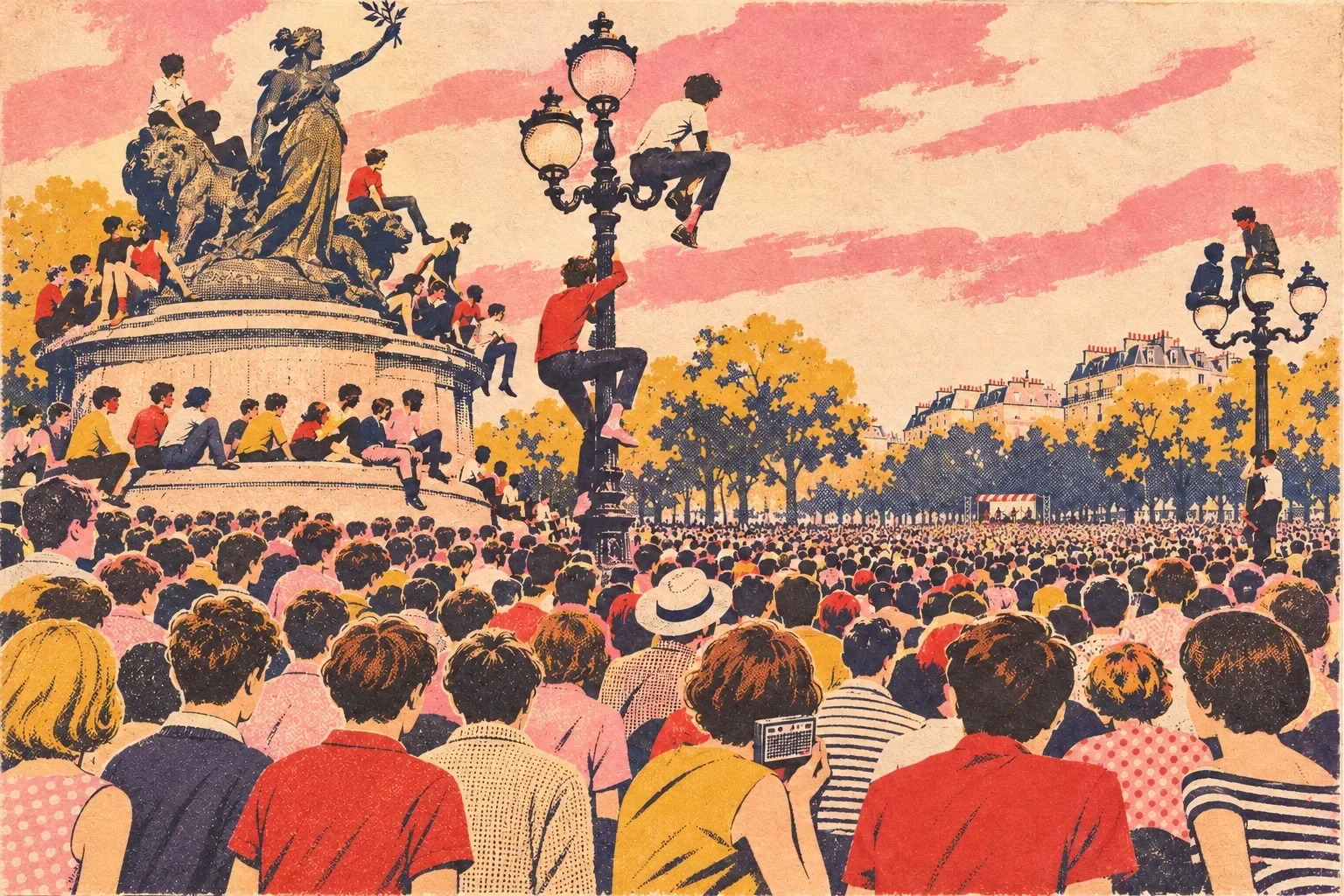
On 22 June 1963, the magazine celebrated its first birthday with a free concert at the Place de la Nation in Paris. A few thousand people were expected. According to the most widely cited estimates, about a hundred and fifty thousand came. Teenagers perched on lampposts, in trees, on the monument. France suddenly saw its children all at once, an entire generation, and took fright.
Two weeks later, the sociologist Edgar Morin published two articles in Le Monde under the heading Salut les copains. The first was called “Une nouvelle classe d’âge”—a new age group. Morin described these teenagers as a people apart, with their own music, clothes, records and transistor radios, and gave them a lasting name: yé-yé. The word was simply a French echo of the English “yeah, yeah” that rang endlessly through the songs.
Le Monde
Salut les copains
I. Une nouvelle classe d'âge — Edgar Morin
The first of the sociologist’s two articles about the teenagers gathered at the Place de la Nation. Here, the generation was given the name “yé-yé”.
Yé-yé had its own constellation of stars: Sylvie Vartan, France Gall, Sheila, Johnny Hallyday, Claude François, Chantal Goya and, from 1966, Jacques Dutronc. And Françoise Hardy. On 12 April 1966, the photographer Jean-Marie Périer assembled forty-six singers for a single staged photograph. Published in June as a poster to mark the magazine’s fourth anniversary, it is still known as the “photo of the century”.
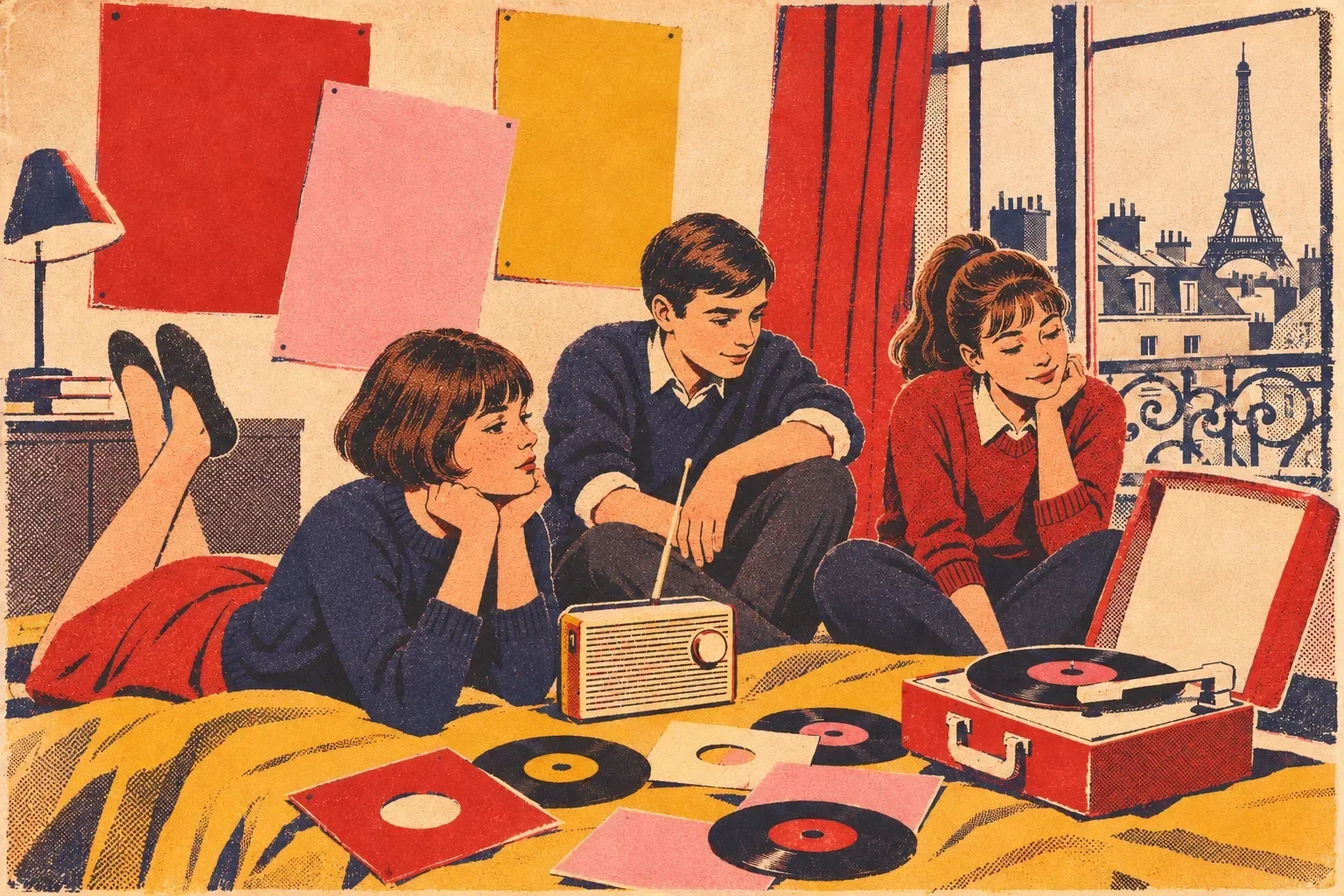
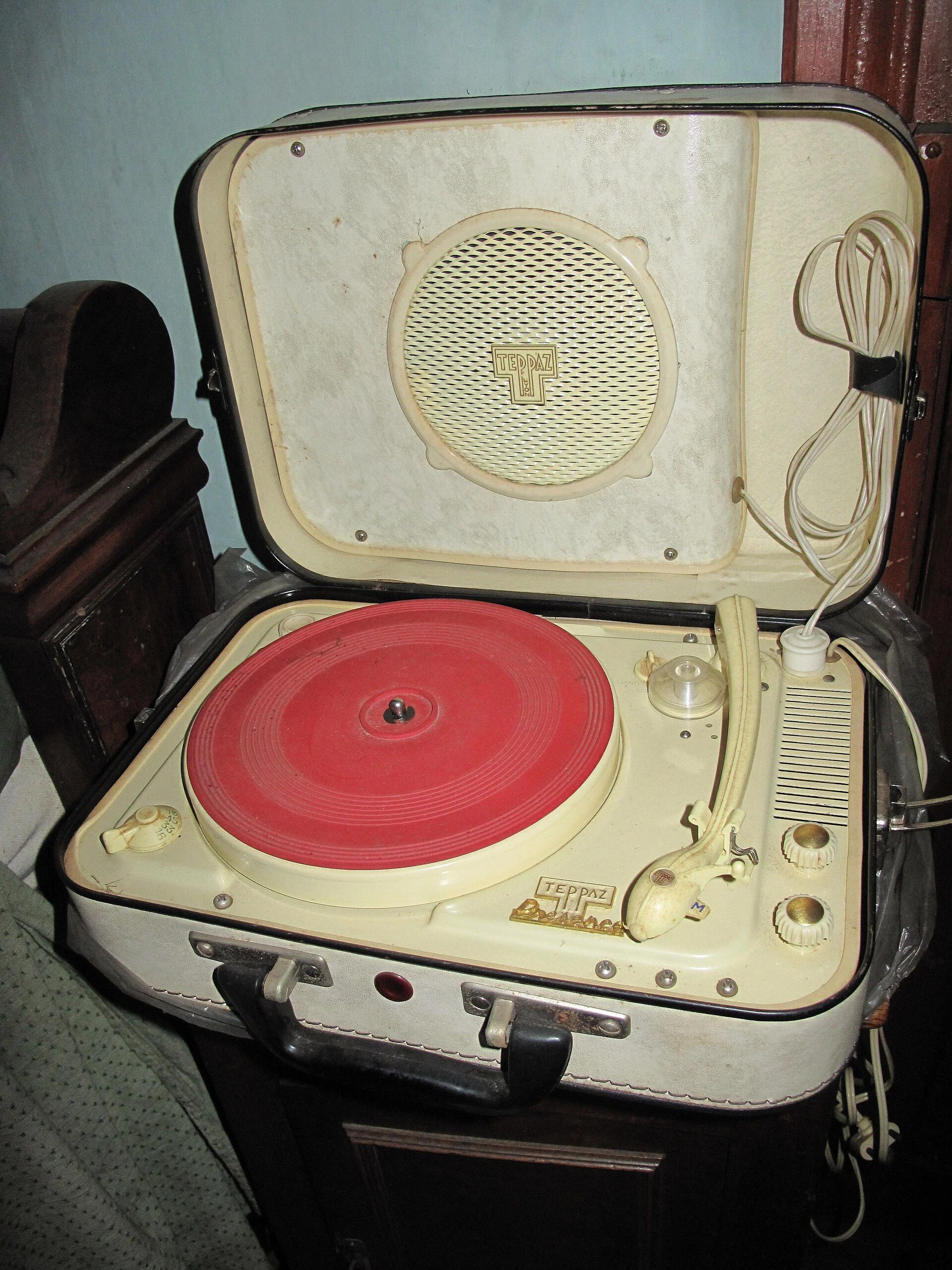
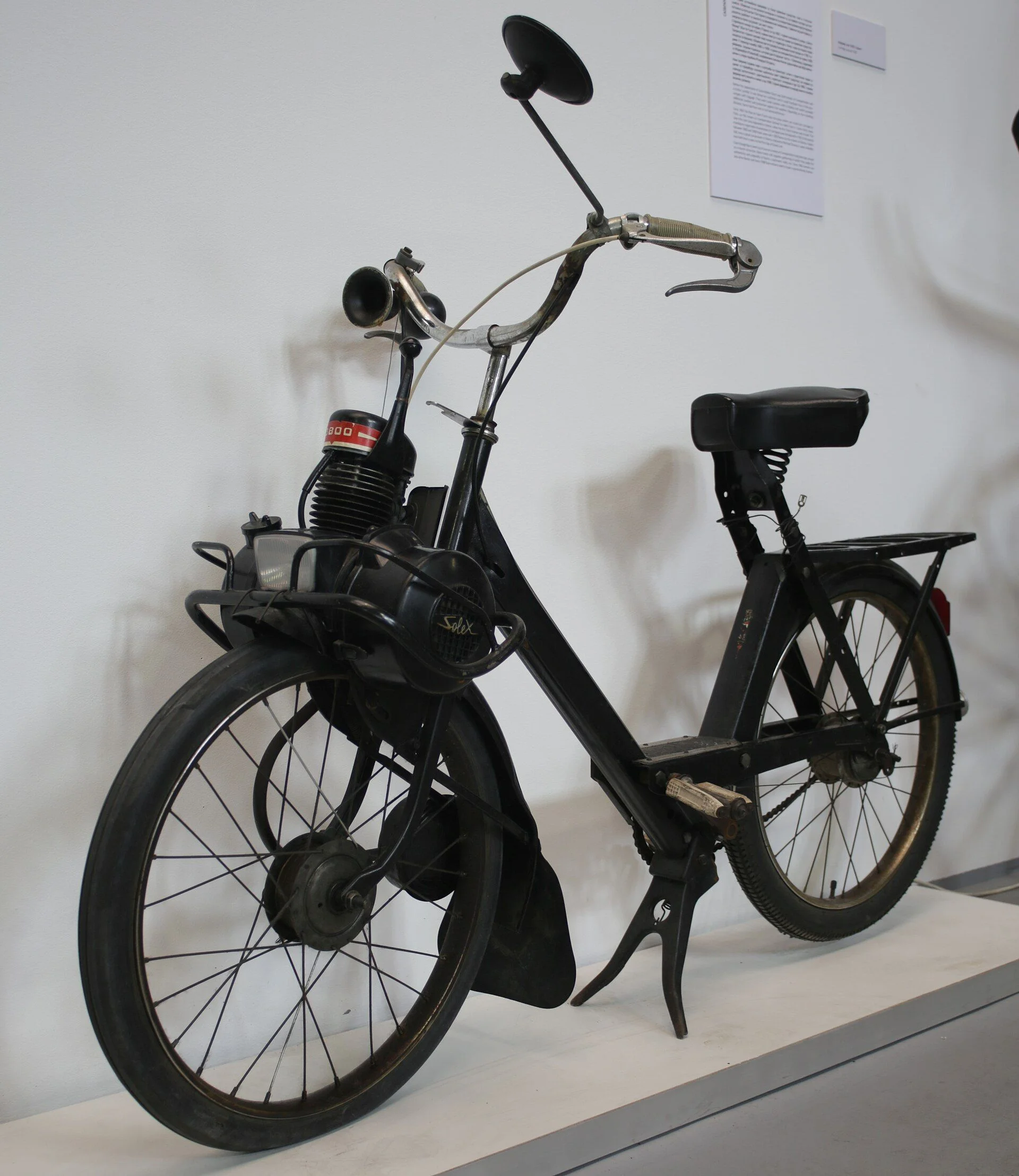
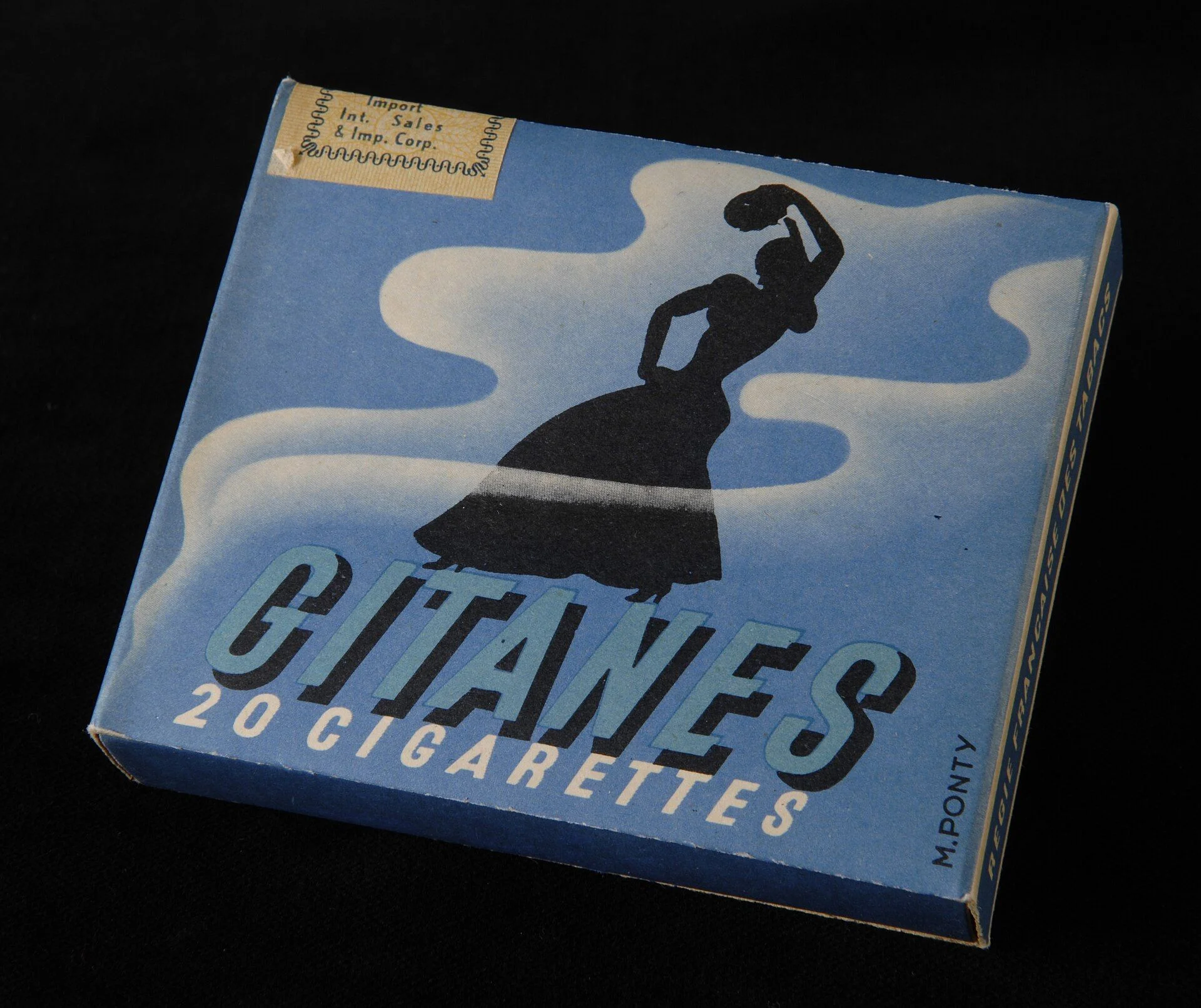
The generation had its objects, too. The portable Teppaz record player, like a little suitcase you could take to the beach or a friend’s house. Small records—45s, or, most often in France, “super 45s”: four songs on one disc in a cardboard picture sleeve. A transistor radio in a leather case. A VéloSolex motorised bicycle. All of it was as much yé-yé as the songs.
Françoise Hardy was born on 17 January 1944 in the ninth arrondissement of Paris, still under German occupation. She was brought up by her mother, Madeleine, an accounts assistant; her father lived with another family and rarely appeared. Françoise and her younger sister attended a Catholic school run by nuns on the Rue La Bruyère. She was a withdrawn, insecure child who read a great deal and listened on the radio to the British and American pop music she would love all her life.
When she passed her baccalauréat, she was given a guitar. Sources disagree about the year: it may have been 1960 or 1961. She knew only a few chords, but they were enough. She began to write. The tune and the words came together, straight from her fingers. Later, she would adopt a different method—music first, words afterwards: “I always put the words on the music.” But this was how the first songs were born.
Then came the auditions. Pathé-Marconi turned her down. An audition at Philips cost money, and she had none. So she went to Le Petit Conservatoire de la chanson, the singer Mireille’s school, which featured on television. On 6 February 1962, eighteen-year-old Françoise made her first appearance on screen: Mireille talks to her, and then she sings.
RTF, 6 February 1962. Mireille’s Le Petit Conservatoire de la chanson.Archive INA / INA Culte
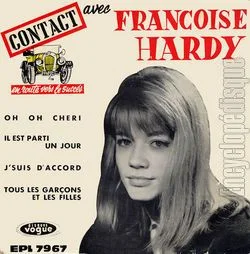
On 14 November 1961, she signed with Disques Vogue—the record company, distinct from the fashion magazine. Its artistic director, Jacques Wolfsohn, had discovered her. On 25 April 1962, she recorded her first disc: four songs on a “super 45”, Vogue EPL 7967. Three of the four were her own. The label initially backed the jaunty Oh oh chéri, printing its title large on the sleeve.
But politics, rather than the sleeve, decided everything. On 28 October 1962, France held a referendum on electing the president by popular vote. That evening, the whole country sat in front of its television sets, waiting for the results. Musical interludes filled the gaps between the figures. In one of them, a quiet girl with a guitar sang Tous les garçons et les filles—“All the boys and girls”. By morning, all France knew her. According to L’Express, five hundred thousand records were sold that year. The sleeve had to be redesigned: now Tous les garçons et les filles and J’suis d’accord took pride of place.
Why this song? In the early sixties, French teenagers mostly sang reworkings of American hits: someone else’s melody fitted with lively French words. The songs were cheerful and loud, about dancing and the promise that everything would be all right.
Hardy sang something else. In Tous les garçons et les filles, a girl walks down the street surrounded by couples—boys and girls her age, holding hands and looking into each other’s eyes. She is alone. And she does not know when someone will finally take her hand, too. No dancing, no twist. A simple melody, as though picked out on a guitar, and a voice that makes no effort to please. Millions of teenagers recognised themselves in this girl. Loneliness, it turned out, could be a hit as well.
This was Hardy’s great contribution to French pop: within the bright world of yé-yé, she began to sing about the things the French chanson tradition had always sung about—longing, uncertainty, sorrow—but in a girl’s voice, rather than a grown-up diva’s. Her own explanation was simple: melancholy melodies had drawn her all her life. “C’est la beauté,” she would answer when asked about sadness. It is beauty.
45 RPM · 1962Tous les garçons et les filles
Tous les garçons et les filles
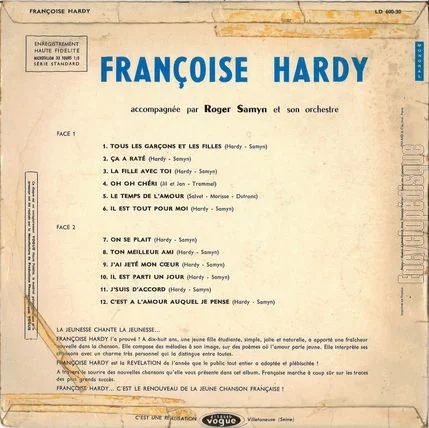
Lyrics by Françoise Hardy; music by Hardy and Roger Samyn
Vogue EPL 7967
A girl alone among couples in love. The simplest melody in the world, and that is its strength. The song took France by storm after the referendum evening of 28 October 1962; in 1964, it reached number thirty-six in the British chart. Its Scopitone film was directed by Claude Lelouch, the future director of Un homme et une femme.
Official Scopitone film, directed by Claude Lelouch
45 RPM · 1962Le Temps de l'amour
Le Temps de l'amour
Lyrics by Lucien Morisse and André Salvet; music by Jacques Dutronc
Love, friends, adventures, and the feeling that youth is slipping away faster than you would like. A springy guitar line. Jacques Dutronc wrote the melody long before he became her husband. Fifty years later, Wes Anderson put the song in Moonrise Kingdom, where two twelve-year-old runaways dance to it on a beach.
45 RPM · 1962J'suis d'accord
J'suis d'accord
Lyrics by Hardy; music by Hardy and Roger Samyn
The spirited side of early Hardy. A girl agrees to be courted—but her agreement comes with conditions. The song appeared on her first record alongside the big hit.
45 RPM · 1963Le Premier Bonheur du jour
Le Premier Bonheur du jour
Lyrics by Frank Gérald; music by Jean Renard
The first happiness of the day lies in the little things that make up love. An intimate, almost domestic song that gave her second album its title. The video comes from the New Year edition of Sacha Distel’s television show, broadcast on 30 December 1963.
Love goes away—and still you look for it again. With this song, the nineteen-year-old Parisienne travelled to the Eurovision Song Contest in London on 23 March 1963. She represented Monaco rather than France and tied for fifth place. The sleeve would later proudly proclaim her a “Eurovision laureate”. She had not won, but all Europe had seen her.
“I would have liked”—another song about what never came to be. In 1964, she recorded it in English as I Wish It Were Me. The video is an archival television performance from INA.
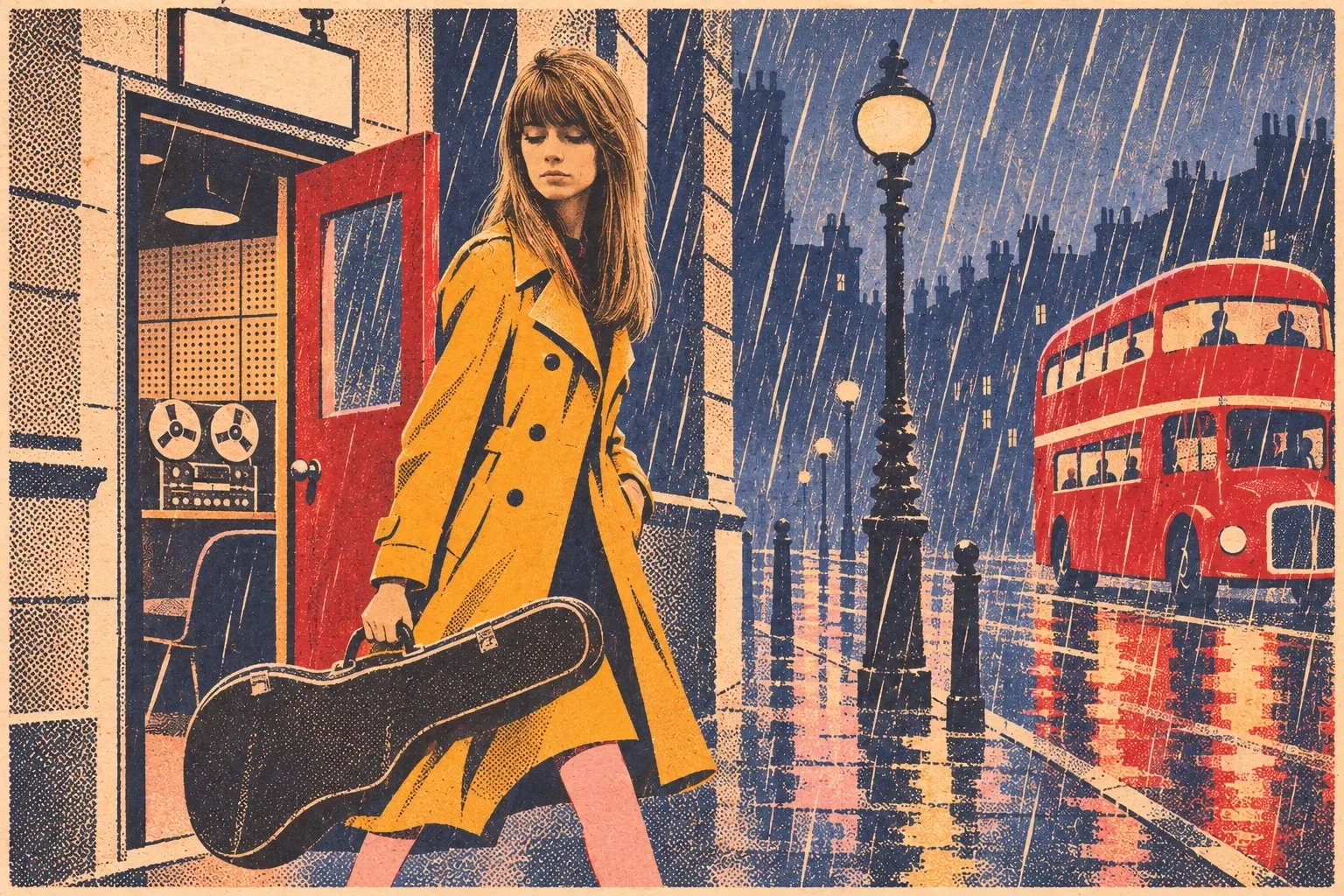
Hardy soon realised she was unhappy with the sound of her records. She listened to British and American pop, but Parisian session musicians played it in their own rather heavy, old-fashioned style. The pop singer Richard Anthony advised her to go to England. From 1964, she recorded at Pye Studios in London with British arrangers—above all Charles Blackwell, but also Tony Hatch, Bob Leaper, Mickey Baker and Johnny Harris.
London in the mid-sixties adored her. Mick Jagger, in a much-repeated quotation, called her his ideal woman. She spent time in Brian Jones and Anita Pallenberg’s circle. Many years later, David Bowie admitted to having been passionately in love with her. Around 1970, she met Nick Drake and wanted to record his songs; the producer Joe Boyd tried to bring them together, but nothing came of it.
45 RPM · 1964Mon amie la rose
Mon amie la rose
Lyrics by Cécile Caulier; music by Caulier and Jacques Lacome
Лондон, студия Pye, аранжировка Чарльза Блэкуэлла
A rose that blooms in the morning and withers by evening—and a girl who understands that the same will happen to her. At twenty, the singer sings about death for the first time, softly and tenderly, which makes it all the more frightening. She did not write the song, but few songs are more completely hers.
“And even if you say you love me, after betrayal nothing will be as it was.” An insistent rhythm, a girl who has made up her mind. In Britain, the song reached number thirty-one.
45 RPM · 1965All Over the World
All Over the World
Music by Hardy (Dans le monde entier); English lyrics by Julian More; arrangement by Charles Blackwell
Her biggest English-language hit: number sixteen in the British chart, where it stayed for fifteen weeks. Love and loneliness understood “all over the world”. A Frenchwoman singing English with an accent had found a home in London.
45 RPM · 1965L'Amitié
L'Amitié
Lyrics by Jean-Max Rivière; music by Gérard Bourgeois
Not every Hardy song is about unhappy love. This one is about friendship as a refuge, about friends who come and go but leave something of themselves with you. Warm and welcoming, it remains one of her best-loved songs in France.
45 RPM · 1965Ce petit cœur
Ce petit cœur
Words and music by Françoise Hardy; Charles Blackwell’s orchestra
A little heart that no promise can tie down. A short, buoyant piece of pop with a London sound. In English, This Little Heart.
45 RPM · 1965Le Temps des souvenirs
Le Temps des souvenirs
French lyrics by Jacques Datin and Maurice Vidalin; music by Charles Blackwell
Here Blackwell is the composer as well as the arranger: this is the French version of his song Just Call and I'll Be There. The memory of love, and the willingness to answer its call.
08
Chapter Eight
A Face for the Cinema
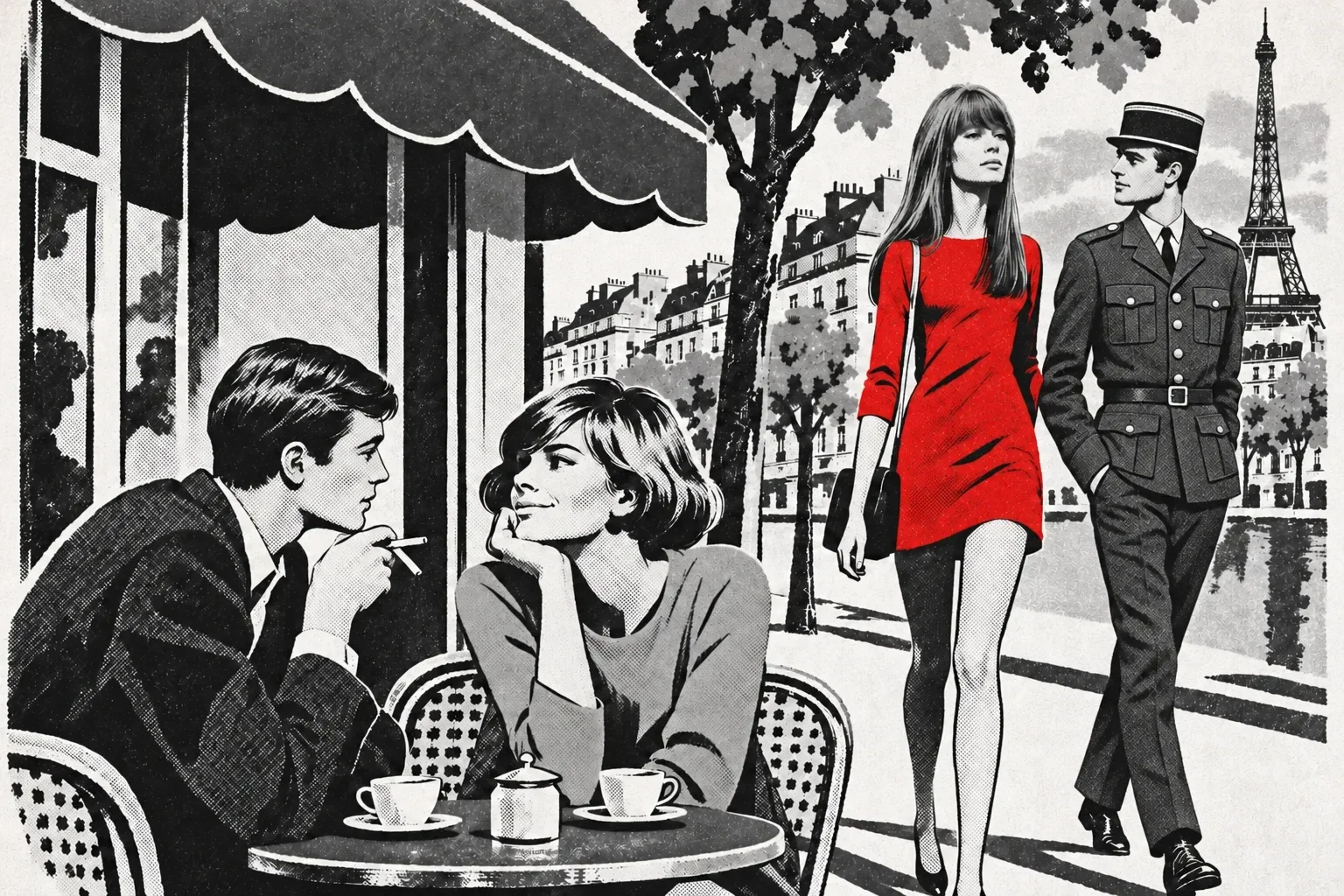
Hardy’s face was made for the camera, and cinema soon noticed. In 1963, Roger Vadim cast her as Ophélie in Château en Suède. In 1966—the very year Dylan waited for her backstage—she appeared fleetingly in Jean-Luc Godard’s Masculin féminin: just a few seconds, crossing the frame beside a soldier. The principal singer in that film was played by another yé-yé star, Chantal Goya. That same year, John Frankenheimer cast Hardy as Lisa in Grand Prix, his Hollywood film about motor racing.
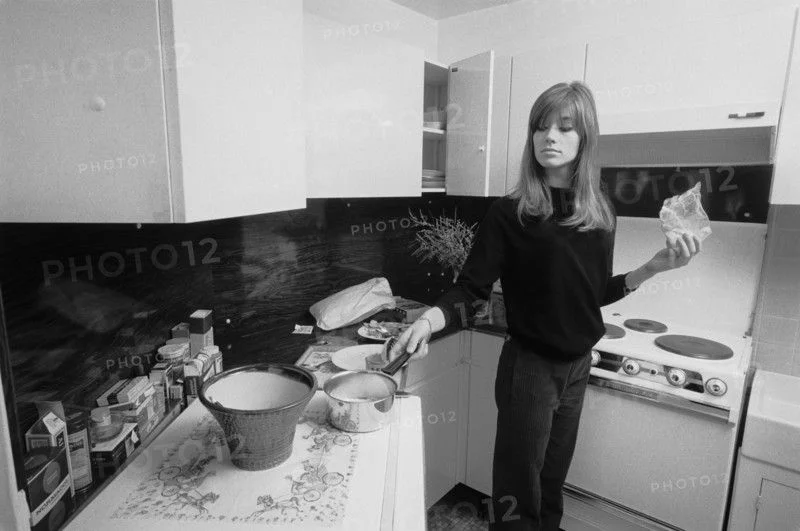
But her real cinema was photography. Jean-Marie Périer, the principal photographer at Salut les copains, was her lover and the creator of her image. He photographed her for the covers: tall, slender, serious, with straight hair and a fringe, against Parisian rooftops and London streets.
People say Hardy was not interested in fashion. It is untrue, or only half true. She disliked dressing up the way other pop singers did, but she chose her clothes deliberately and knew exactly what suited her. What suited her, as it happened, were things no female singer before her had thought to wear.
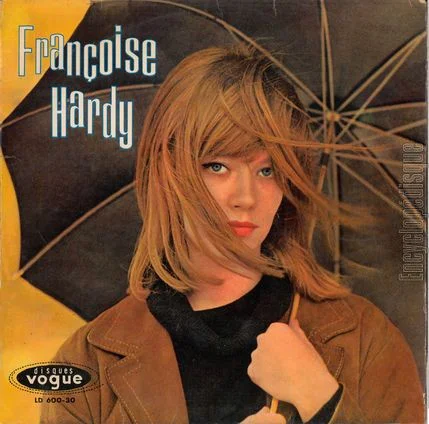
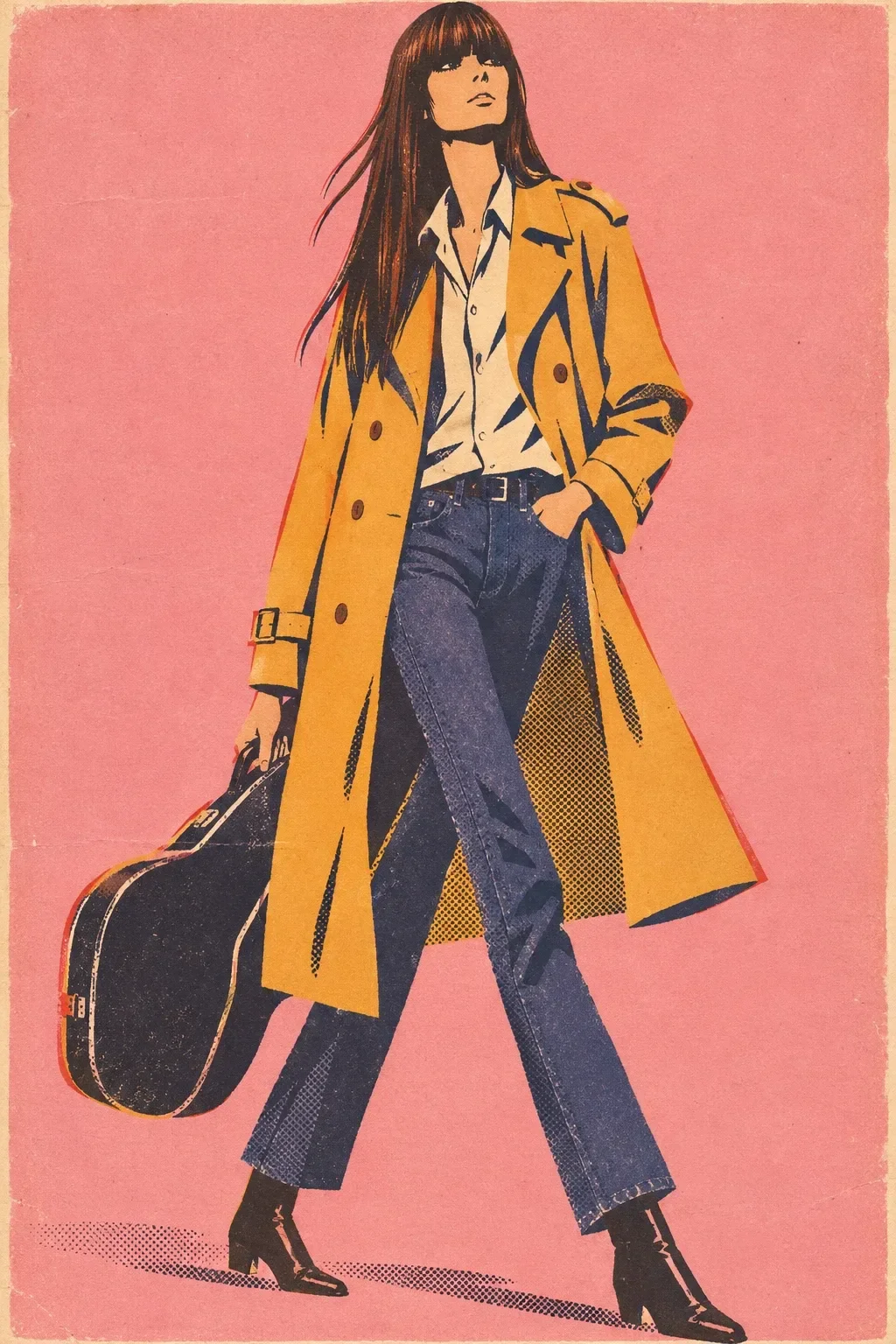
She was unusually tall for her time, with narrow shoulders, long legs and an almost boyish figure. The full skirts and lace of the fifties would have looked alien on her. But a man’s shirt, straight-leg jeans, a trench coat, trousers, a short shift dress and flat boots looked as though they had been invented for her. Long, straight hair, a heavy fringe down to her eyebrows, almost no make-up and a solemn, faintly sad face. Within a few years, half the young women in Europe would want to look like that.
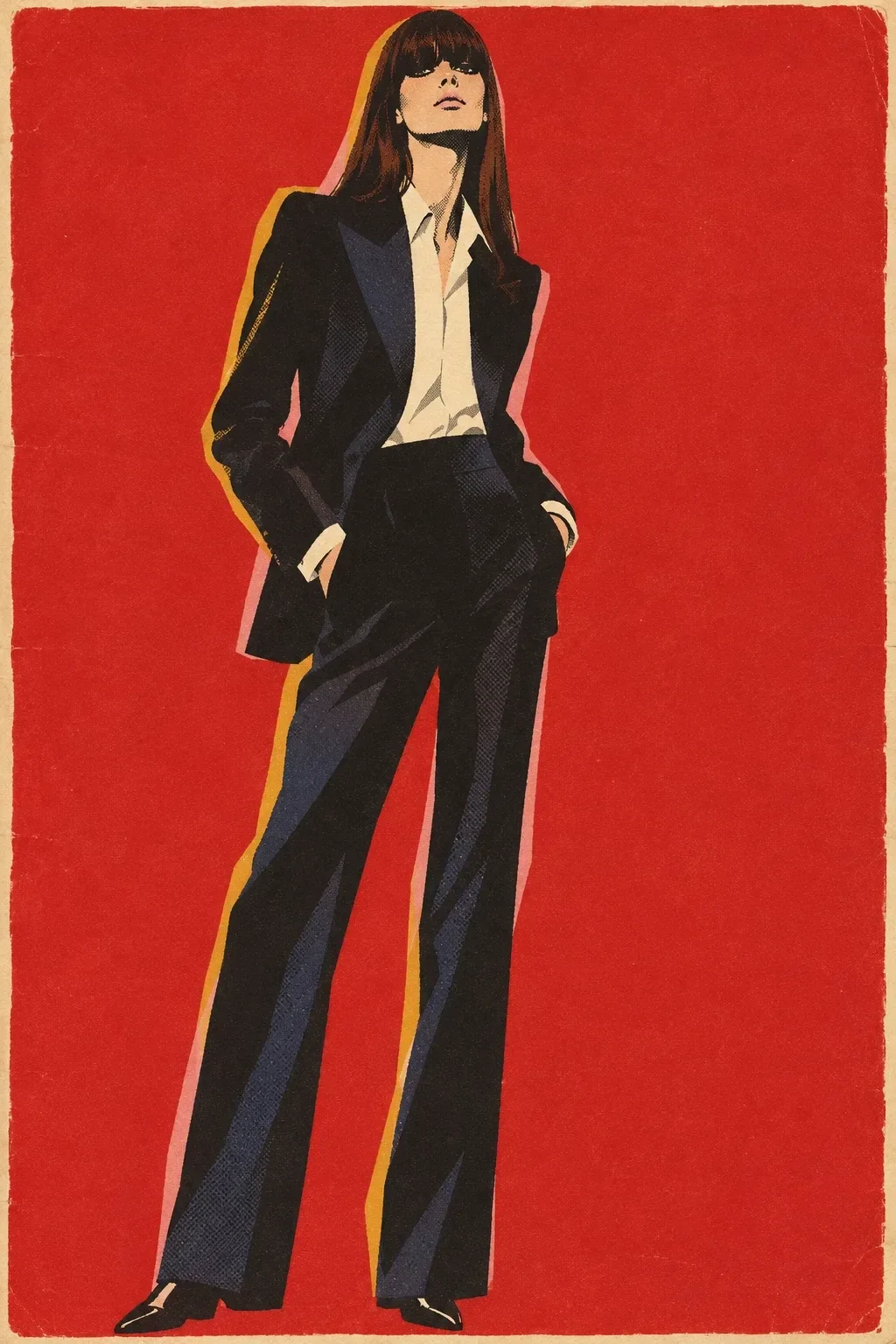
Courrèges, 1965
Yves Saint Laurent, 1967
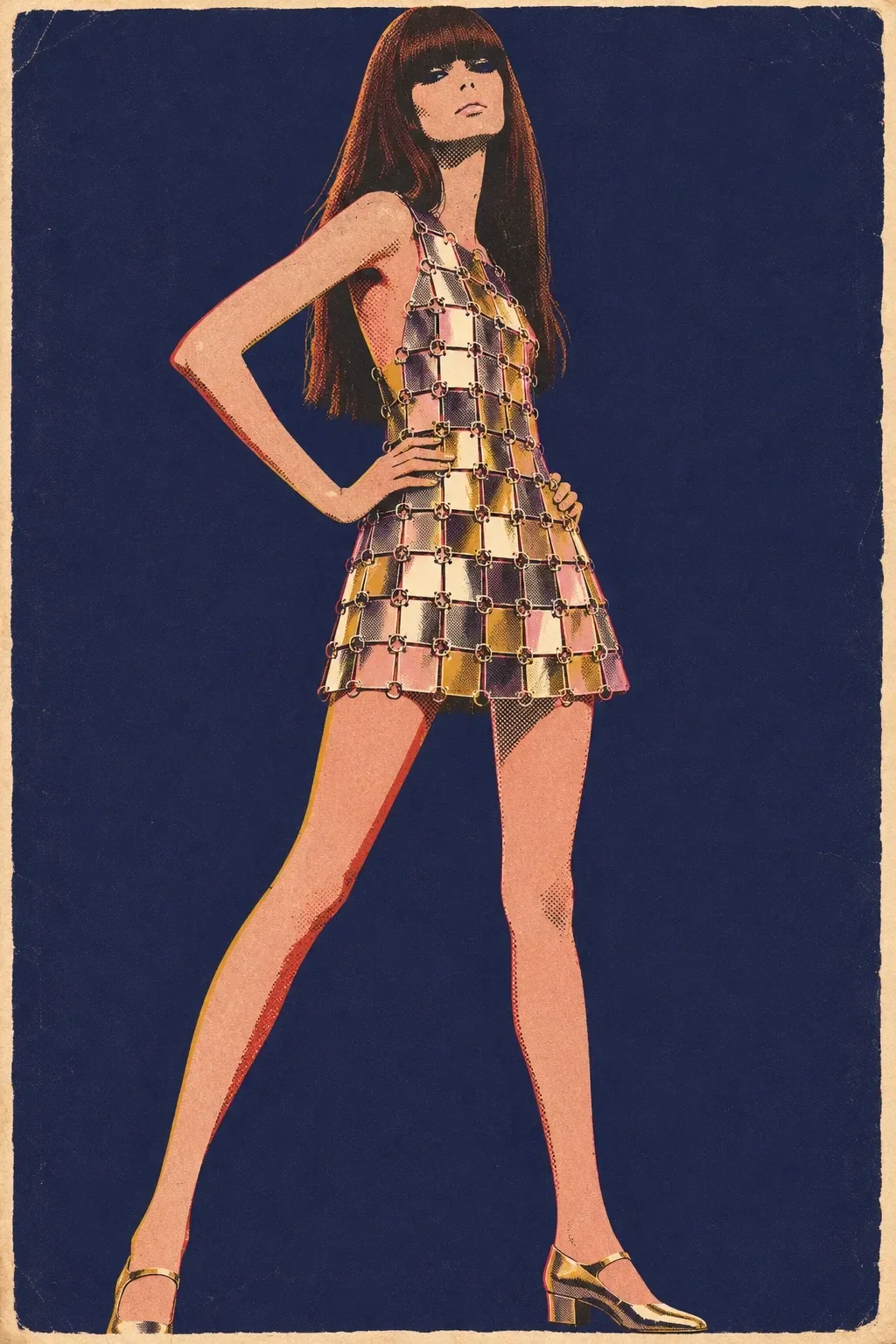
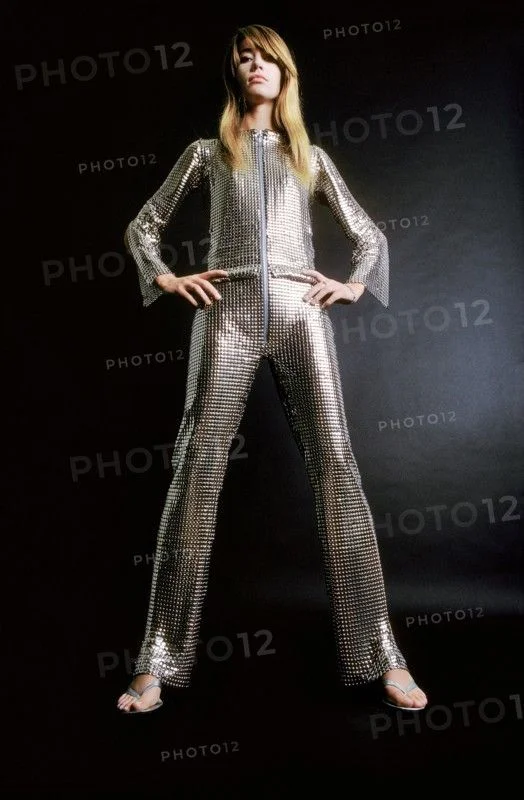
Paco Rabanne, 1968
On Her Own Terms
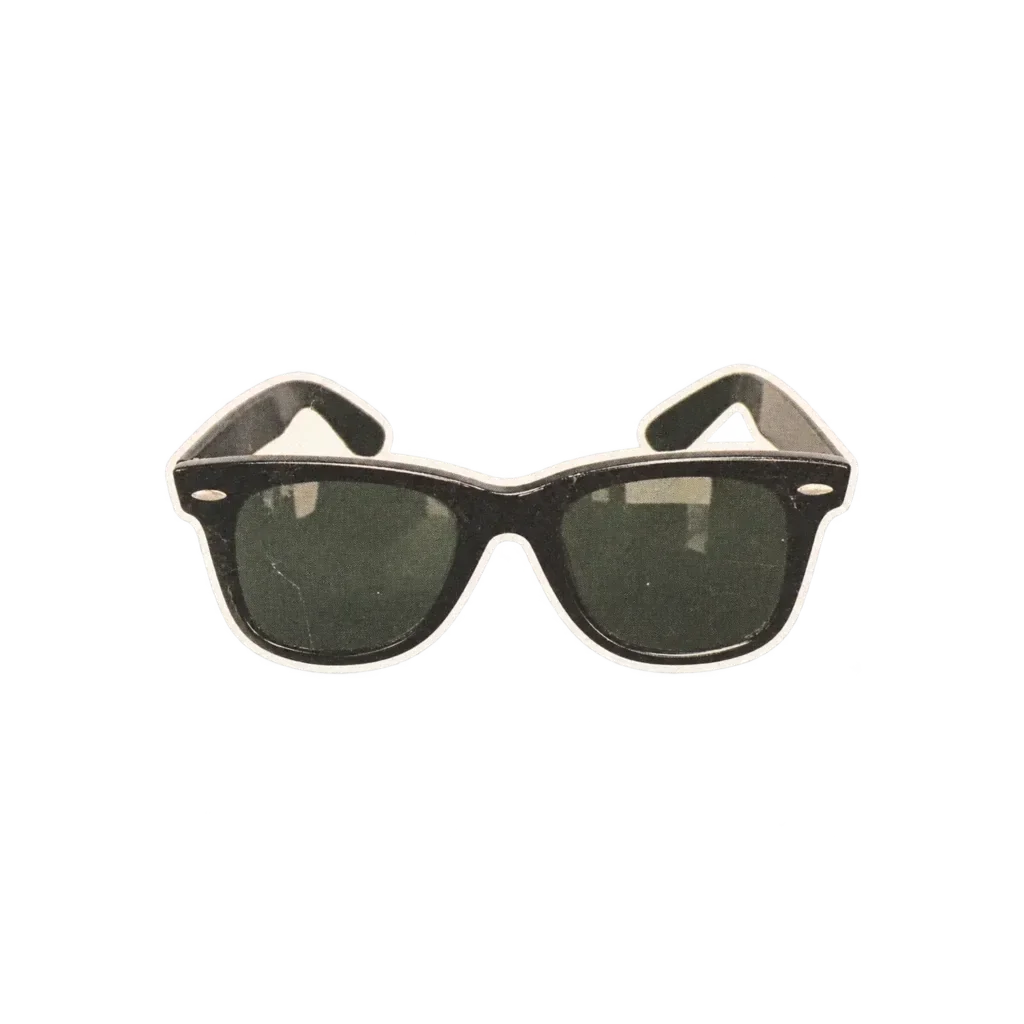
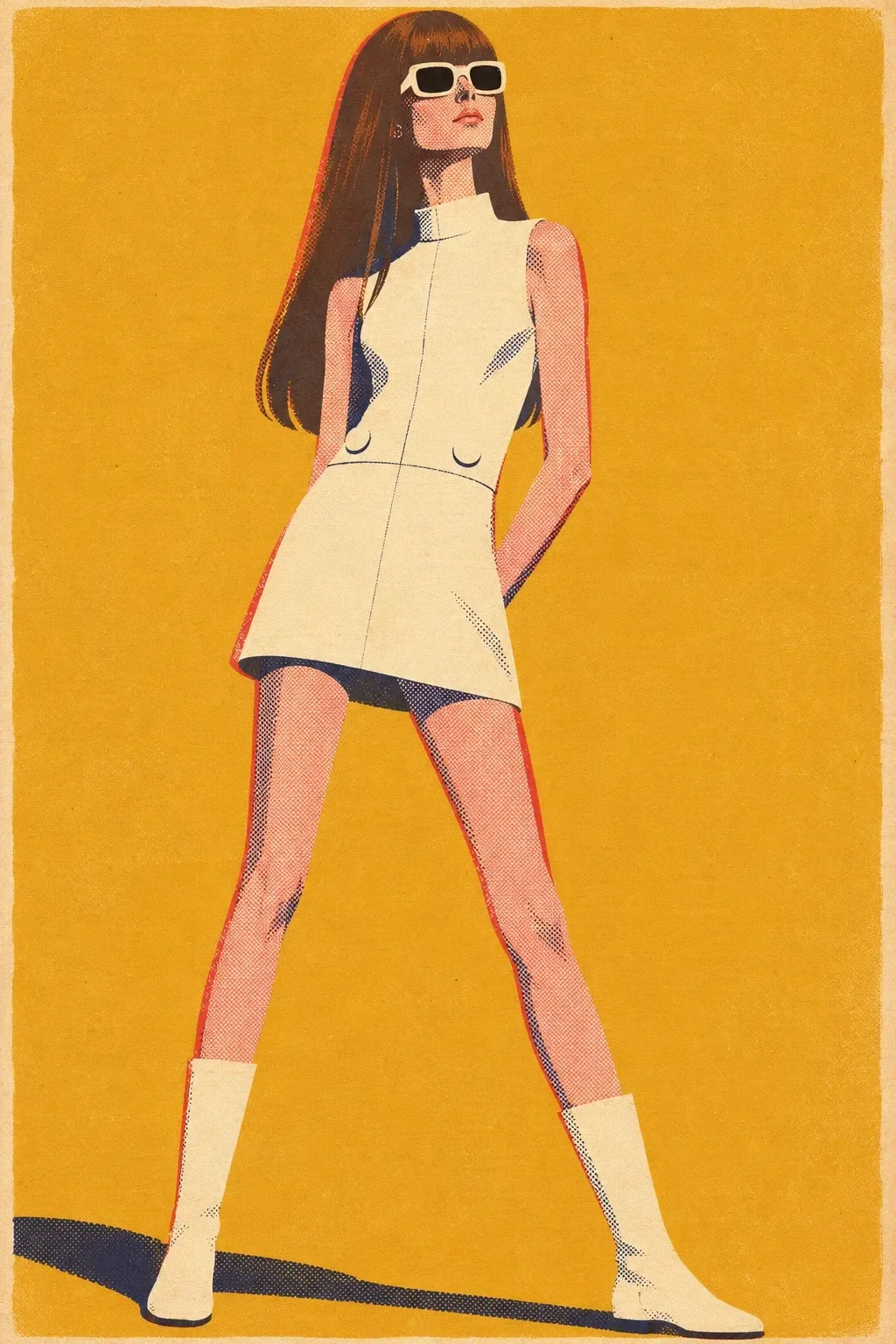
Courrèges. In the mid-sixties, the designer André Courrèges invented “space-age” fashion: white geometric A-line dresses above the knee, flat white boots, slit sunglasses. Hardy became one of its faces onstage. She herself remembered performing in a white Courrèges tunic.
The mini. Her wardrobe also included a miniskirt by the London designer Mary Quant. Hardy was not the first woman in the world to wear a mini, as is sometimes claimed. But she was among the first to wear one in France so naturally that it seemed she could hardly have worn anything else.
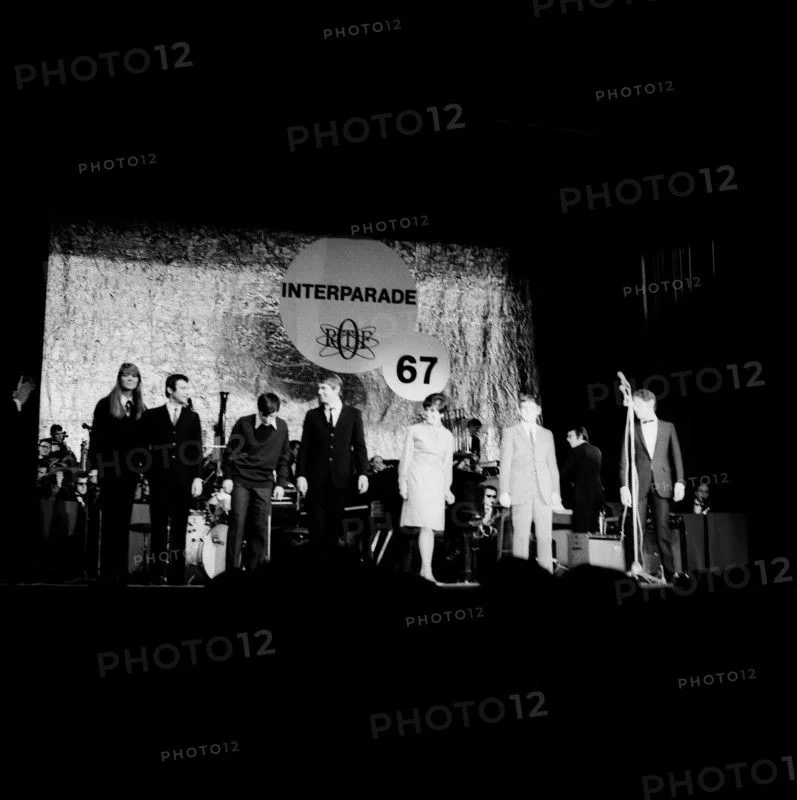
Interparade, Olympia, 25 January 1967. Hardy in an Yves Saint Laurent dinner suit.Фото: André Crudo / Photo12
Le Smoking. In the autumn of 1966, Yves Saint Laurent unveiled Le Smoking, a dinner jacket and trousers for women. At the time, a woman in trousers could still be refused entry to a restaurant. On 25 January 1967, Hardy wore one onstage at the Olympia for the Interparade gala, and the photographer André Crudo captured it. There is also a story that an audience at the Paris Opéra booed her for wearing a dinner suit; when this happened, and which photograph records it, could not be established.
Gold. Paco Rabanne made dresses from metal plates joined by little rings, working with pliers rather than a needle. In May 1968, while Paris was building barricades, he made Hardy a dress of gold plates. The house of Rabanne describes nine kilograms of pure gold; Vogue mentions a thousand plates and three hundred carats of diamonds. Rabanne explained that he saw in her a combination of distance, modernity, strength and romanticism. It is hard to put it better.
Afterwards. Her style outlasted the fashions she wore. The trench coat, the straight-leg jeans, the man’s shirt, the fringe: these are still reference points whenever anyone speaks of “French chic”. Alexa Chung named Hardy as her style icon. Critics saw echoes of her in Hedi Slimane’s collections for Celine. Hardy herself said she found it ridiculous to be called an icon.
By 1967, yé-yé was coming to an end. The teenagers of the Place de la Nation had grown up; a year later, they would take to the barricades. Hardy had grown up, too, and so had her songs. In 1967, she released an album named after the song Ma jeunesse fout le camp—“My youth is slipping away”. In 1968, she stopped giving concerts: stage fright had won. She was leaving the stage, not music. She continued to sing in the studio and on television.
In that same year, 1967, she began a relationship with Jacques Dutronc—the very man who had once written the music for Le Temps de l’amour. Their son Thomas was born in 1973; they married in 1981.
45 RPM · 1967Ma jeunesse fout le camp…
Ma jeunesse fout le camp…
Words and music by Guy Bontempelli
At twenty-three, a song about youth slipping away. Teenage melancholy becomes a meditation on time. The grown-up Hardy begins here.
45 RPM · 1966La Maison où j'ai grandi
La Maison où j'ai grandi
French lyrics by Eddy Marnay; music by Adriano Celentano
The French version of Celentano’s Il ragazzo della via Gluck, about a childhood home demolished and a city that swallowed a meadow. Nostalgia for a world that no longer exists. It is not about her own home, but she sings as though it were.
45 RPM · 1967Des ronds dans l'eau
Des ronds dans l'eau
Lyrics by Pierre Barouh; music by Raymond Le Sénéchal
Ripples on water: what remains of a thrown stone, of childhood, of love. A song from the world of Claude Lelouch and his film Vivre pour vivre. In English, Now You Want to Be Loved.
45 RPM · 1968Comment te dire adieu
Comment te dire adieu
French lyrics by Serge Gainsbourg; original song, It Hurts to Say Goodbye, by Arnold Goland and Jack Gold
Gainsbourg rewrote the American song in French so that the same dry “ex” rhyme rings through every line, as though the words themselves were stumbling, unable to bring themselves to say goodbye. Light, brisk pop to break up to. One of her defining songs; the video shows a television performance from 28 February 1969.
Il n’y a pas d’amour heureux—“There is no happy love”: Aragon’s wartime poem, set to music by Brassens. A pop singer steps into the world of great French poetry and sings it without grand gestures, in the same even voice she used for the boys and girls.
Hardy began the seventies with the record many consider her finest. She made La Question in 1971 with the Brazilian singer and guitarist Tuca, who wrote almost all the music. A voice, an acoustic guitar, Guy Pedersen’s double bass and strings—nothing more. Quiet, sensual and uneasy, the album anticipated the vogue for such music by thirty years. Stereolab’s singer Lætitia Sadier said that La Question, in particular, had meant a great deal to her.
Then came Michel Berger, and in 1973, Message personnel: a song that begins with Hardy speaking rather than singing, as though leaving an answering-machine message for someone she cannot bring herself to tell how she feels. In the late seventies came the unexpected disco-funk of J’écoute de la musique saoule, with the composer Gabriel Yared. Alongside her music, she began to study astrology seriously and wrote several books about it.
45 RPM · 1971La Question
La Question
Lyrics by Hardy; music by Tuca
A question the beloved never answers. A voice almost whispering, Tuca’s guitar, the feeling of an intimate conversation in a dimly lit room.
45 RPM · 1973Message personnel
Message personnel
Lyrics by Michel Berger and Françoise Hardy; music by Berger
First she speaks, then she begins to sing, and the distance between two people becomes almost physical. She wrote the famous spoken introduction herself. One of the best-loved French songs of the seventies.
To leave, to leave anyway, even though you love. A grown-up ballad that reached number thirty-three in the French chart. Soon she would announce that her career was over. It was not.
She returned in the nineties and found that people born after yé-yé had ended were waiting for her. In March 1995, Blur recorded a French version of their song To the End with her at Abbey Road. In 1996, she released the hard-edged, electric album Le Danger. In 1997, she sang the old standard I’ll Be Seeing You with Iggy Pop. She wrote the lyrics to Jeanne for Air. In 2000, she and Dutronc sang Puisque vous partez en voyage, a song by her teacher Mireille.
45 RPM · 1995To the End (La Comédie)
To the End (La Comédie)
Blur and Françoise Hardy. Lyrics by Damon Albarn; music by Blur
Britpop meets chanson. Damon Albarn sings in English, she answers in French—almost the same conversation in two languages as on that night at the George V, except that this time everyone understands.
Lyrics by Hardy; music by Pascale Daniel and Alain Lubrano
She wrote it thinking of her son Thomas, when she was already ill. A mother comforts her son: if I am gone, love will remain, and there will still be so much beauty around you. Her voice is restrained, without a single tear—which is why the listener cries.
45 RPM · 2018Le Large
Le Large
Words and music by La Grande Sophie; video directed by François Ozon
Her last great song. To set out for the open sea, calmly, without complaint. François Ozon directed the video. Personne d’autre was released on 6 April 2018 and would be her final album.
For her last twenty years, she was seriously ill: lymphoma, then cancer of the larynx. Treatment took away her voice. Françoise Hardy died on 11 June 2024, aged eighty. Her son Thomas announced her death.
12
Chapter Twelve
Echoes
What did she change in music? She proved that a young woman inside the vast pop industry could sing her own songs—about her shyness, her uncertainty, her loneliness—and that millions of people needed to hear them. She was not the first woman in France to write songs. But she was the first yé-yé star to sing her own material rather than someone else’s, and to sing quietly when everyone was shouting.
Her echo can be heard in those who openly acknowledged her: Lætitia Sadier and Stereolab; Air, with whom she worked; Bob Stanley of Saint Etienne; Étienne Daho, for whom, in the words of the French Ministry of Culture, she was “un modèle et une idole”—a role model and an idol. On the day she died, Belle and Sebastian were playing in Nîmes, and sang Comment te dire adieu in her memory.
When asked about the sadness she had sung of all her life, she answered with two words: “C’est la beauté”. It is beauty.