DORMER ·
Who Keeps the Balance
Picasso’s Young Acrobat on a Ball: on lightness and weight, on a love where it is unclear who holds whom, and on the portrait hidden on the back of the canvas
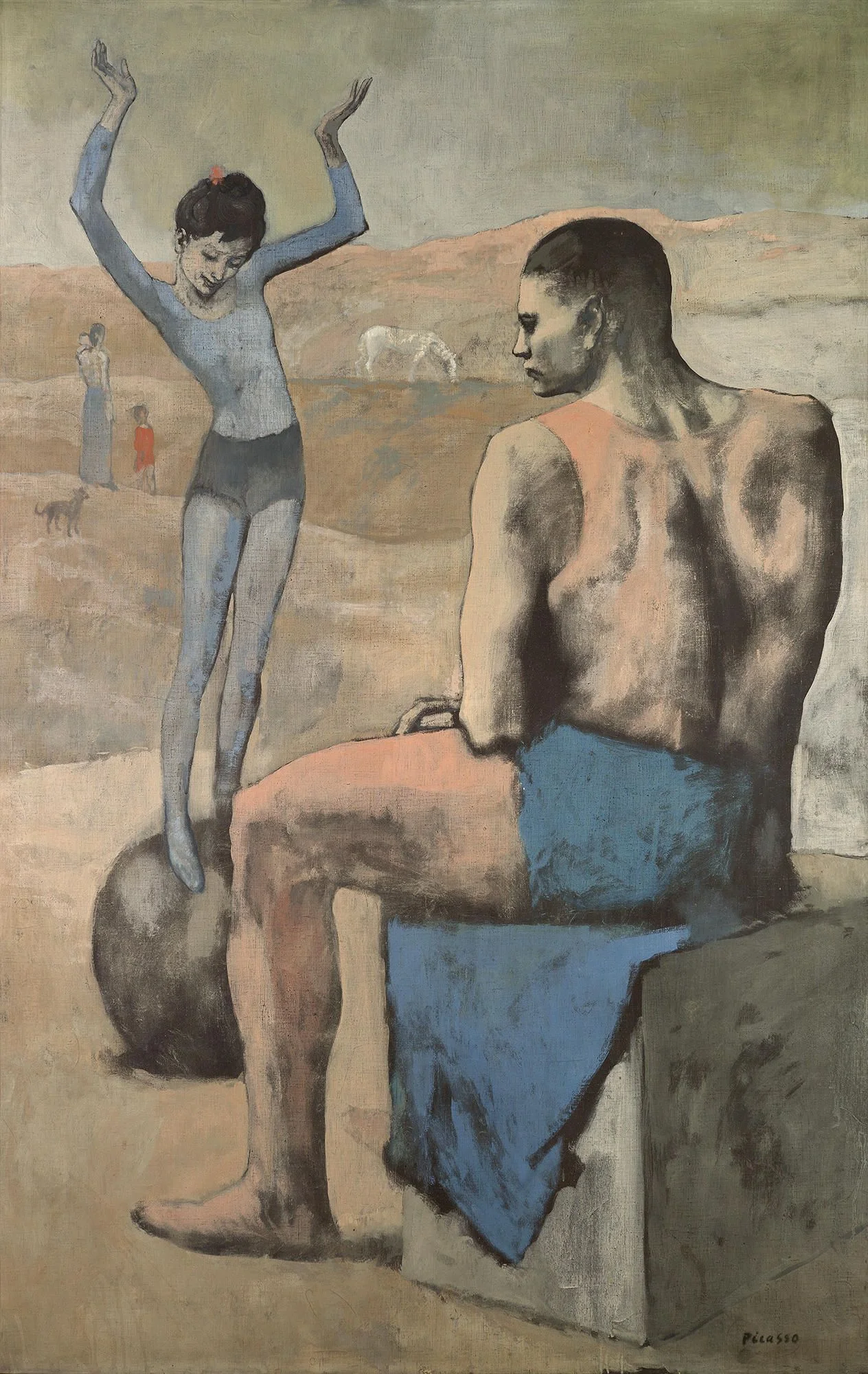
He and she
It is one of the best-known paintings in Russia. People have seen it on stamps, coins, in textbooks and on posters; a story and a film are named after it, and figure skaters have skated to it. Picasso painted it in Paris in 1905, aged twenty-three, and since 1913 it has lived in Moscow, now in the Pushkin Museum.
There are two people in it. A slender girl acrobat balances on a ball, stretched upwards, light, almost bodiless. And beside her, with his back to us, a huge athlete sits on a heavy cube. He is the strongest figure in the picture and probably in the whole travelling troupe. Yet he sits as if that strength had long been of no use to him: shoulders lowered, face in shadow, hand on his knee.
We will look at this painting as a story about love — the kind where one is light and airy and the other heavy, tired and broken for all his strength, and where it is unclear who holds whom. A caveat up front: this is our reading. The Pushkin Museum sees the athlete differently, as a regal protector, and we will come to that argument. But first, let us simply look at the painting, detail by detail. Scroll down and the picture will move closer to whatever is being discussed.
- 01
Her
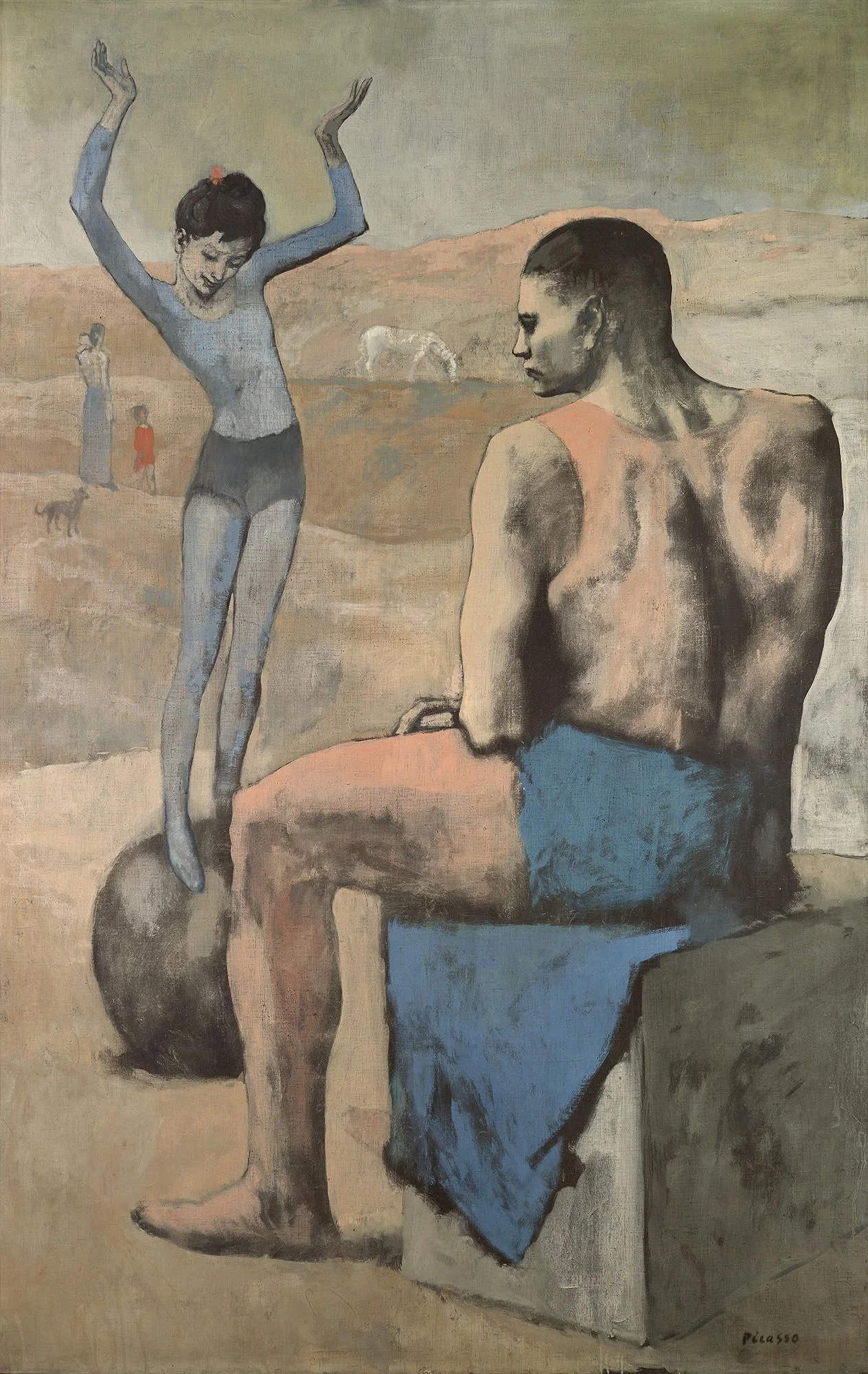
The girl stands on the ball on the very tips of her toes, feet almost together, both arms raised above her head. The figure is stretched further than living bodies are, so she seems to weigh no more than the air around her. Her leotard is blue, like the sky between the clouds, painted with the same colours as everything heavenly in the picture.
- 02
A flower and a downward glance
In her hair is a red flower, one of the two brightest spots on the whole canvas. Her head is bent, her eyes lowered: she looks neither at us nor at him, but at her feet, where it is being decided whether she will fall. Her lightness is concentration.
- 03
The hands
The fingers are spread, the left hand higher than the right. Look at the sky around the hands: the paint is so thin here that the weave of the canvas shows through, and the outline of the hand is drawn in a dark line right over the painting. Picasso draws with the brush as with a pencil.
- 04
The ball
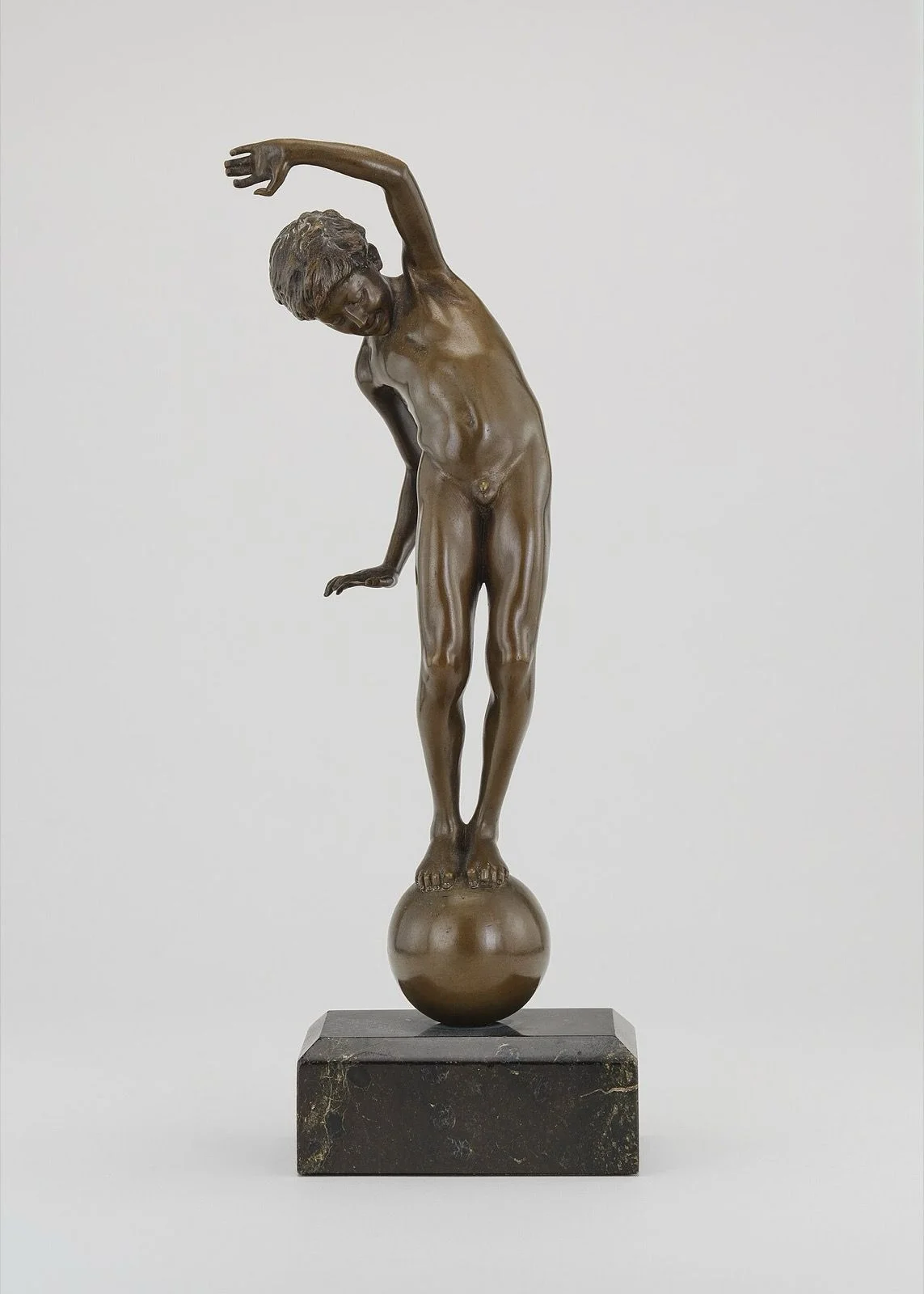
The ball is dark and heavy, its lower half almost merging with the ground. The feet touch it at a single point. No one can hold such a pose for more than a few seconds, so it was almost certainly not painted from life: Picasso’s biographer John Richardson looked for its source in a Berlin bronze, Boy Balancing on a Ball.
- 05
His face
The athlete sits with his back to us, head turned in profile towards her. His face is almost entirely in shadow: a dark eye, pressed lips, a head small for such a body. He watches the girl, but there is neither admiration nor sternness in his gaze, only weary attention.
- 06
The back
The back takes up almost half of the foreground. It is pinkish ochre, like the scorched earth behind him, modelled with broad, rubbed strokes and dark patches in the shadows. Picasso enlarged him on purpose: seated, the athlete’s head almost reaches the chest of the girl standing on her ball. This is not a body but a rock.
- 07
A hand on the knee
His hand simply rests on his knee. All the strength in that body is directed at nothing right now. He is not preparing to catch her if she falls, nor helping her stand. He sits.
- 08
The cube
Beneath him is a heavy grey-brown cube, its right edge cut off by the frame. The blue cloth hanging from it rhymes with the girl’s leotard: the only colour that connects them. The ball is unstable; the cube is immovable. On one you cannot stand still; from the other you cannot move.
- 09
The white horse
In the middle of the empty scorched landscape a white horse grazes, head lowered. There were white horses at the Médrano circus, where Picasso went several evenings a week, and in 1905 Apollinaire wrote of white horses among the acrobats. The horse does not look at them.
- 10
A woman, children and a dog
On the left, far off, a woman in a long dress holds a baby, a child in red beside her and a dark dog below. Probably the same travelling troupe. And none of them, like the horse, watches the trick. The hardest thing in the picture happens for a single spectator.
- 11
The signature
In the lower right corner, in dark paint: Picasso. No date. He is twenty-three or twenty-four, poor, and does not yet know that this picture will be printed on stamps and struck on coins in the country where it will end up eight years later.
1904–1905
Montmartre, an attic and a circus
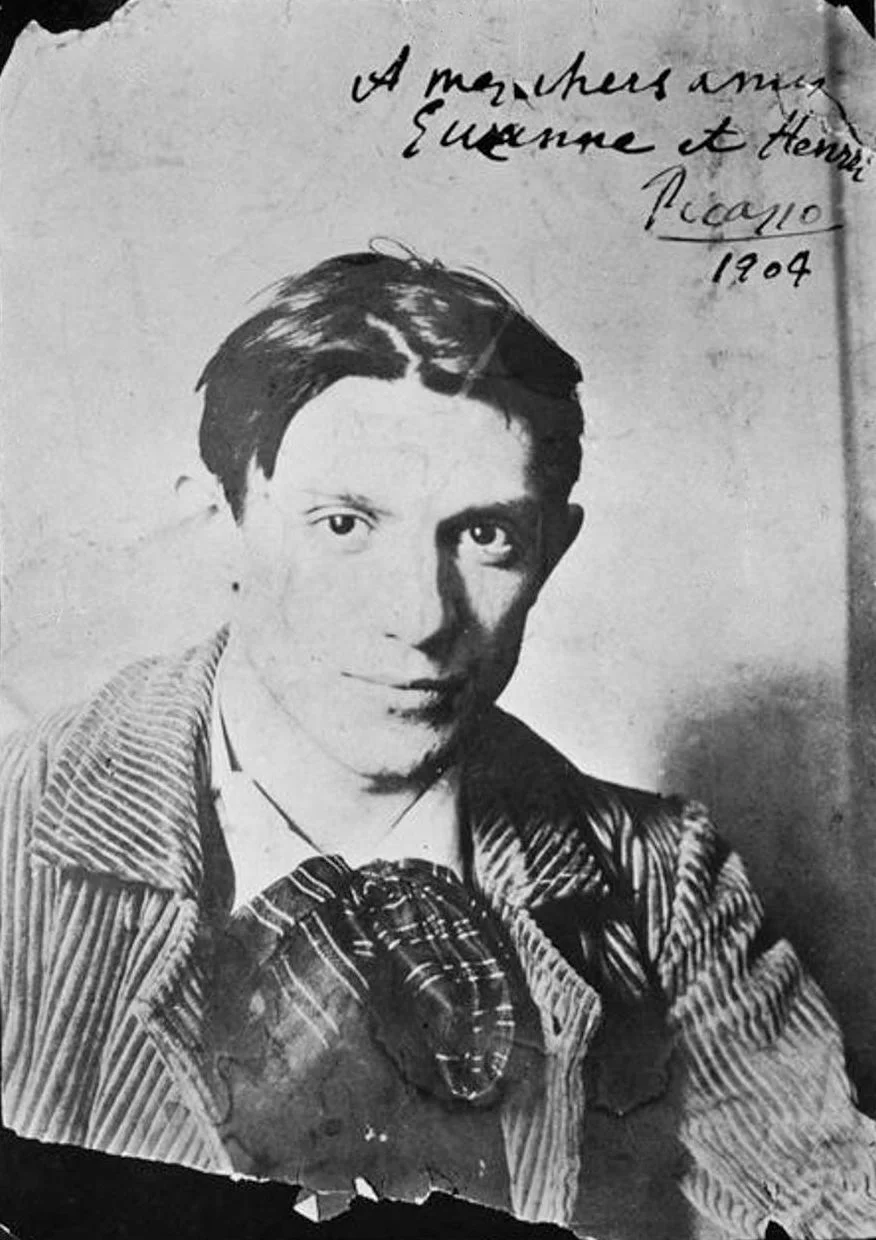
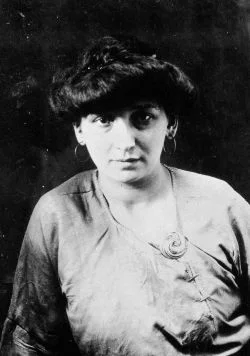
In 1904 Picasso moved from Barcelona to Paris for good and settled in Montmartre, in a building nicknamed the Bateau-Lavoir, the ‘laundry boat’. The Pushkin Museum describes it as a whimsical house made only of attics and cellars. There, in 1904, he met Fernande Olivier, who became his lover for the years that followed.
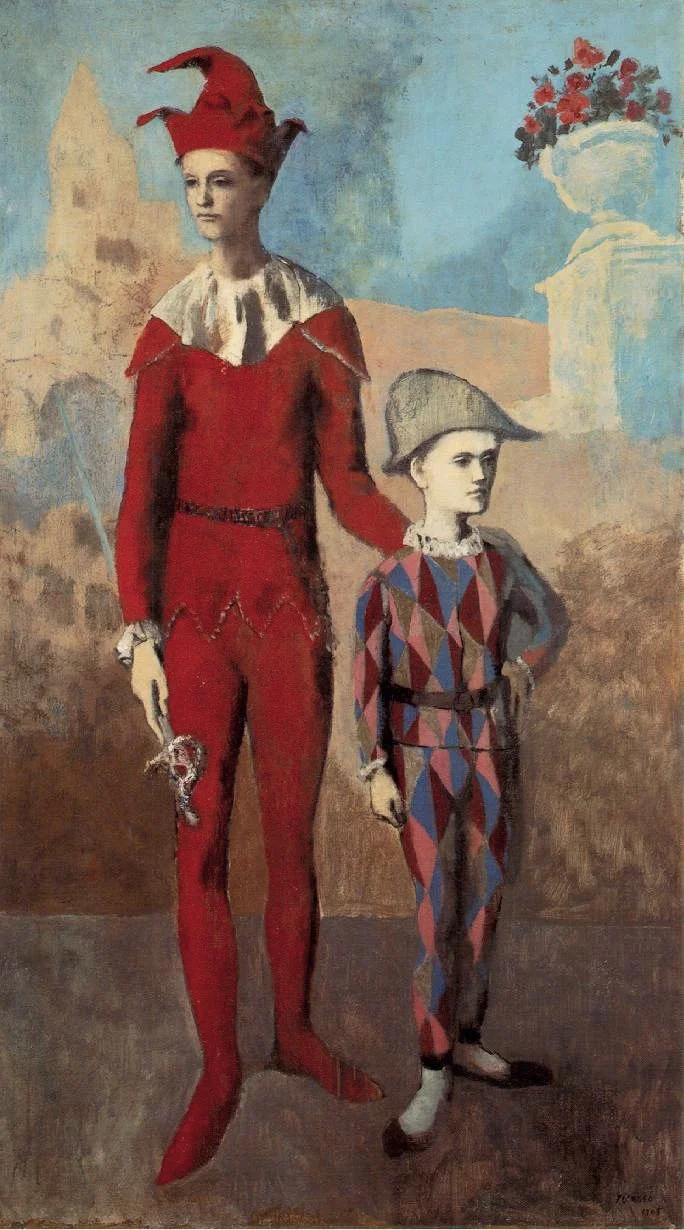
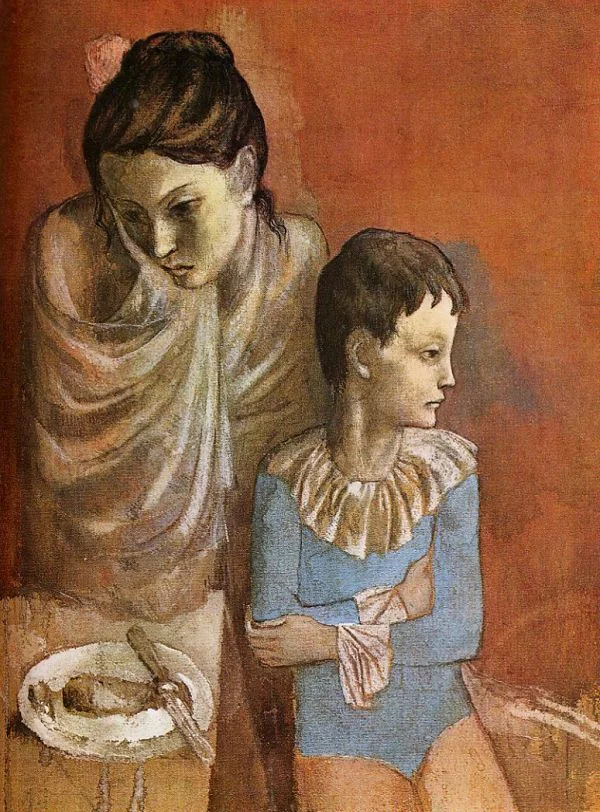
His Blue Period had just ended: beggars, the blind, the sick, all painted in cold blue. His friend Jaime Sabartés recalled that Picasso then believed art was born of sadness and pain. Now pink and ochre tones appeared, and instead of beggars came travelling acrobats, harlequins and circus people.
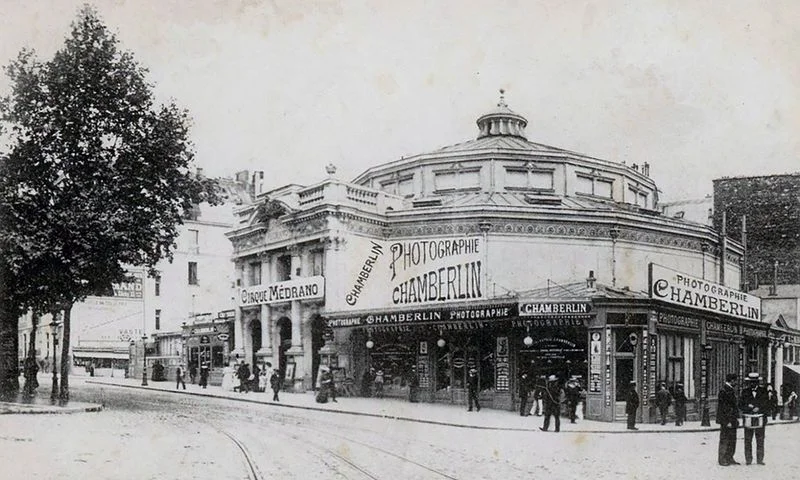
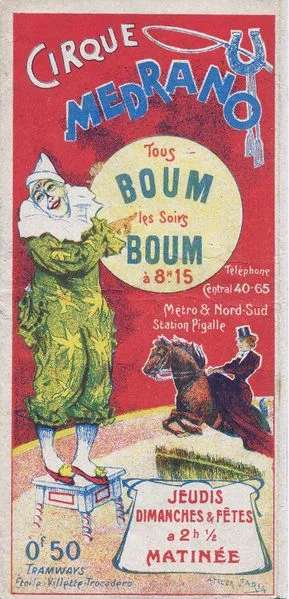
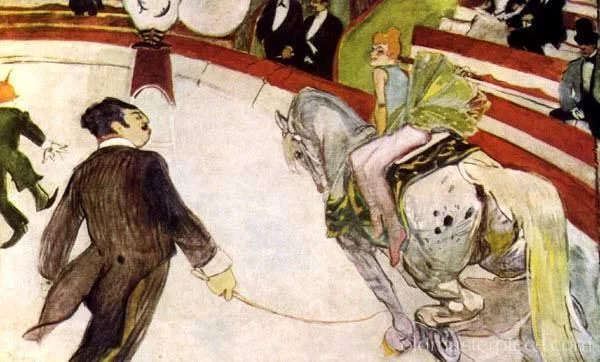
The circus was close by, at the foot of Montmartre: the Médrano. Picasso later recalled that he was really under the spell of the circus and sometimes came three or four nights a week. Gertrude Stein wrote that their whole crowd met at the Médrano at least once a week and befriended the clowns, jugglers and riders. Fernande Olivier added that Picasso admired the clowns and had real sympathy for them. The American scholar E. A. Carmean even suggested the Rose Period might owe its name to the pink tent of the Médrano, though that is only a hypothesis.





A picture inside a picture
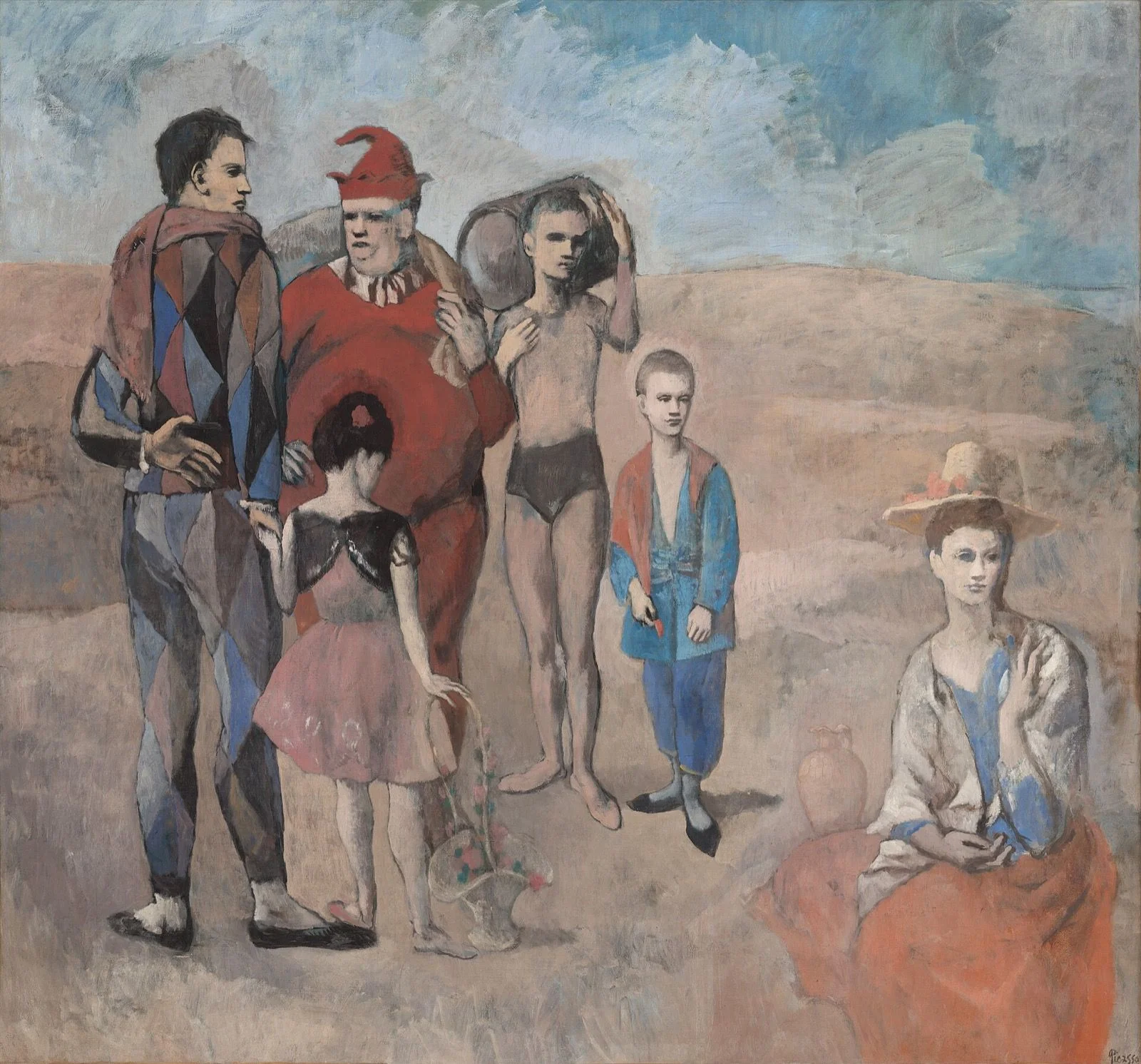
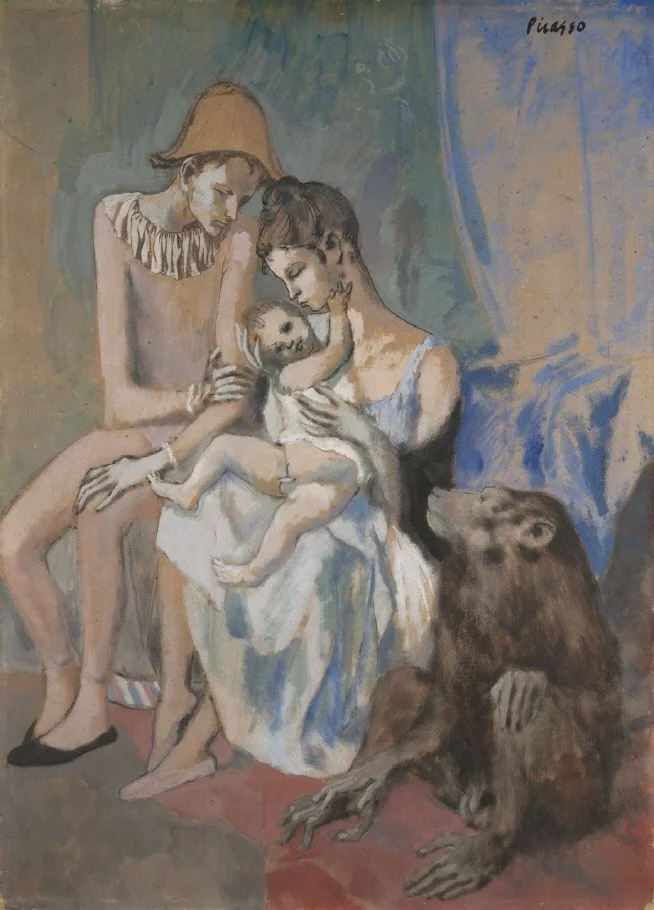
The girl on the ball was born inside another painting. In spring 1905 Picasso was working on a huge canvas of a travelling troupe, now called Family of Saltimbanques, in the National Gallery in Washington. X-rays and a preparatory watercolour show that the first version had a child balancing on a ball, with Harlequin beside it, hands on hips, studying it. Fernande Olivier remembered that first large picture this way: a child is trying to balance on a large ball, and the canvas was repainted several times.
Then Picasso painted the episode out, and the girl on the ball is gone from the Washington picture. Beneath its paint, incidentally, there is also a white horse, and a second child’s leg shows over the ball. He moved the girl to a canvas of her own and seated an athlete beside her instead of Harlequin. Pen sketches survive too: a girl balancing on a block, and a study for the painting itself.
Where does the pose come from? Richardson linked it to a bronze by the Berlin sculptor Johannes Götz, Boy Balancing on a Ball, modelled in 1888, a cast of which is in the same National Gallery in Washington. One can stand as the girl stands for only a few seconds, so painting her from a live model would have been nearly impossible. Who posed for the girl and the athlete is unknown; Richardson thought the athlete might have been a Médrano acquaintance.





The other side
The most unexpected story of this painting is hidden on the other side of the canvas. The Pushkin Museum’s conservators call the canvas ‘turned’: on its reverse is another, unfinished image. The art historian Anatoly Babin tells more. The canvas first served for an earlier portrait of a man; then Picasso turned it over and painted the girl on the ball on the back. Richardson explained it simply: the artist was poor and saved money.
For forty years people argued about who was in the portrait. In 1979 the Pushkin’s Picasso curator Marina Bessonova gave Babin the X-rays. Babin was sure it was the Basque painter Francisco Iturrino, with whom Picasso had exhibited at the dealer Vollard’s in summer 1901. Bessonova and the Leningrad art historian Anatoly Podoksik believed it was the artist’s father, José Ruiz Blasco. The decisive evidence was a 1901 photograph in Richardson’s book showing Picasso in his studio in front of that very portrait of Iturrino. According to Babin, Bessonova accepted this version in the museum’s 2001 catalogue.
The reverse has a practical consequence too. The paint layer is fragile and sensitive to humidity and vibration. Before the Paris exhibition of 2018 the museum seriously doubted whether it could be lent at all, and the conservators built a special mounting system for the journey.
The mattness of a fresco
In 1905 the poet Guillaume Apollinaire, newly befriended by Picasso, wrote of his new paintings that the colour has the mattness of frescoes and the lines are firm. The Pushkin Museum applies these words directly to the girl on the ball, and up close you see why. The paint lies in a thin, matt, almost dry layer, and in the sky around the girl’s raised arms the canvas weave shows through. There is no gloss and no thick impasto anywhere.
The second thing visible up close is drawing. The outlines of the girl’s arms, hands and face are traced with a dark line over the paint, as if with a pencil. The athlete’s back, by contrast, is modelled with broad, rubbed strokes and dark washes in the shadows. Picasso does not draw it; he sculpts it.
And the third is colour. For the whole painting Picasso has essentially two pairs of colours: a warm pinkish ochre for the earth and the athlete’s body, and a cool blue for the girl’s leotard, the cloth on the cube and the sky. The Pushkin Museum notes that the landscape is painted in almost the same ashen pinkish-bluish tones as the figures, blurring the difference between people and land. There are only two bright spots: the red flower in the girl’s hair and the red clothes of the child far away.
The colour has the mattness of frescoes; the lines are firm.
The ball and the cube
There are only two geometric shapes in the painting, and both carry meaning. The ball is something you cannot stand still on: it keeps rolling, and balance on it lasts seconds. The cube is something you cannot move from: heavy, stable, cut by the edge of the canvas as if it went beyond the frame and grew into the earth.
Anatoly Babin saw an old emblem here: in the Renaissance it was said that the seat of Fortune is round and the seat of Virtue square. Fortune, luck, stands on a ball because luck is fickle; Virtue sits on a cube because it is reliable. The American art historian Meyer Schapiro read it differently: the acrobat’s balance is for him an image of the artist’s own work, constantly adjusting lines and masses. And the author of the 1980 Washington exhibition catalogue, E. A. Carmean, framed the pair’s central opposition in three pairs of words: grace and strength, light and heavy, actor and observer.
Grace and strength, light and heavy, actor and observer.
Him
The Pushkin Museum’s official reading is this. The athlete is like an Egyptian pharaoh sitting regally on the cube. The girl’s fragility underlines his strength, and his strength seems to shield her from the cruelty of reality. Travelling acrobats are outcasts and need one another: a world of people who need each other. The art historian Nina Dmitrieva called such a troupe an ideal model of a family.
We will read him differently, and this is our reading, not the museum’s. Look at his posture again. A pharaoh would sit upright; this man sits leaning forward, shoulders lowered, his head small for such a back and sunk in shadow. His hand does not hold, is not ready to catch — it just lies on his knee. All the enormous strength Picasso so stressed is directed at nothing. It is the strength of a man tired of carrying it.
And then the painting becomes a story about love — where he looks up at her, heavy, still, pressed down by his own weight, while she stands above him on the ball, weightless, all effort not to fall, and does not even look at him. She keeps her balance herself. He only watches. Perhaps it is he who holds on to her — to the fact that such lightness still exists in the world. The museum sees a protector. We see a man held on earth only by the fact that she exists.
The athlete’s might seems to shield her from the cruelty of reality.
A background that does not look
Behind the two figures lies an empty scorched landscape of pinkish-ochre hills under a greenish-grey sky. Podoksik saw mountainous Spain in these hills and the travelling troupes Picasso remembered from childhood. In the middle a white horse grazes; far to the left a woman with a baby, a child in red and a dog.
In 1905 Apollinaire wrote of Picasso’s acrobats almost in these words: among familiar monkeys, white horses and dogs; the animals teach them religious mystery; they celebrate mute rites with difficult agility. Of the girls on the balls he wrote that they command these spheres with the radiant movement of worlds. Whether he meant this very painting cannot be established from the text, but no one has put it better.
Notice that no one in the background watches the trick. Not the horse, not the mother, not the child, not the dog. The online magazine Kultura Moskvy read this as art going unwanted. For us it is a sign that the whole picture happens between two people: she does the hardest thing in the world for a single spectator.
From Paris to Moscow
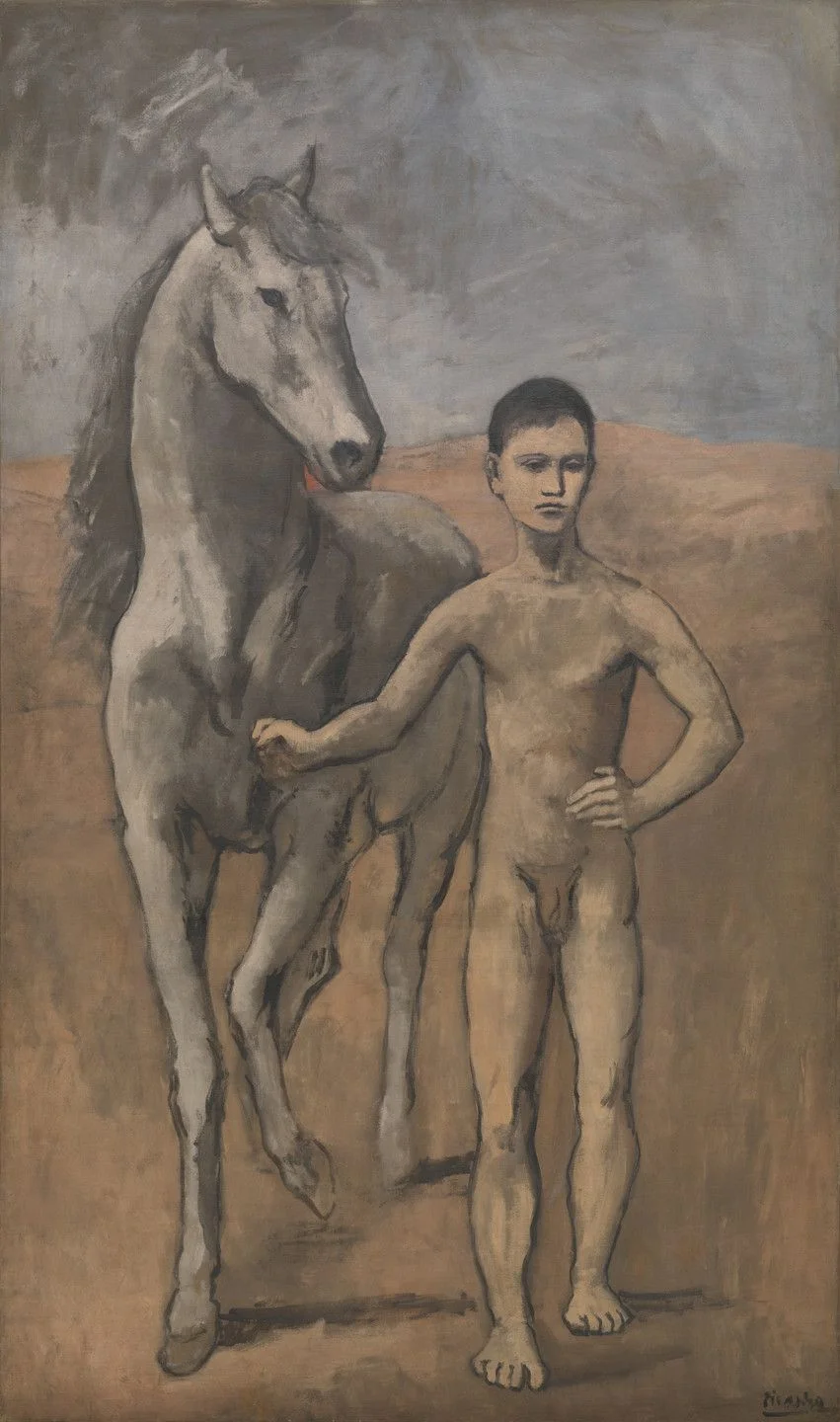
The first owners were the Americans Leo and Gertrude Stein, brother and sister, among the first to buy Picasso. When and from whom they bought it is unknown, but in a photograph of their Paris flat on the rue de Fleurus taken around 1907 the girl on the ball already hangs on the wall beside Boy Leading a Horse.
In 1913 the siblings fell out and divided the collection. The dealer Daniel-Henry Kahnweiler valued the girl on the ball at ten thousand francs. On 17 October 1913 Gertrude gave it to Kahnweiler with two other early works in exchange for Picasso’s new Cubist Man with a Guitar. The new Picasso, it seems, now interested her more than the old.
Kahnweiler immediately resold the girl to the Moscow industrialist Ivan Morozov. Sources disagree on what he paid: thirteen or sixteen thousand francs. For comparison, Morozov had bought Picasso’s Two Acrobats from Vollard for just three hundred. In all, Morozov owned only three Picassos; his rival Sergei Shchukin had about fifty.
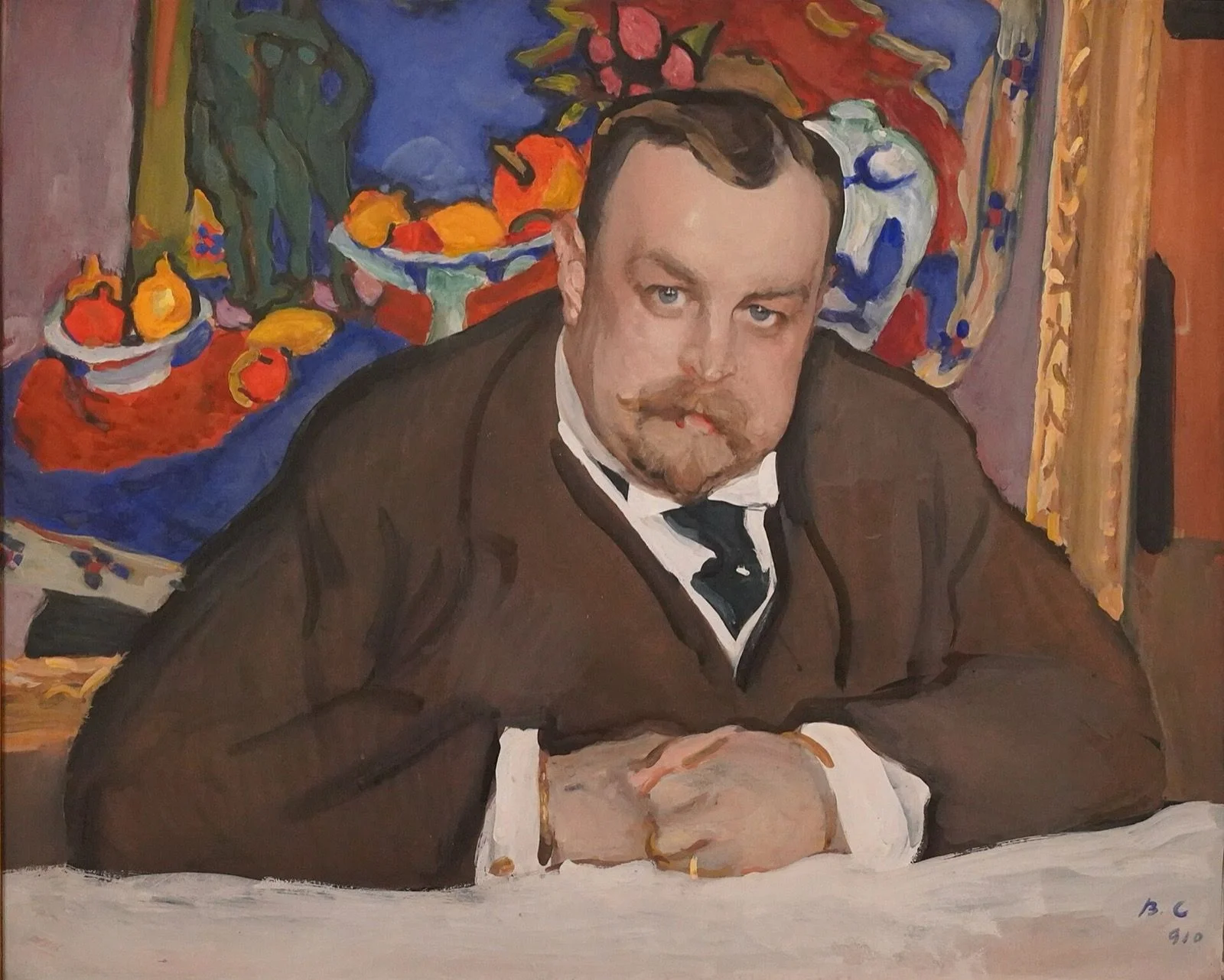

Storerooms and a queue
Five years after the purchase Morozov’s collection was nationalised. In 1919 it became a museum, Morozov himself was appointed deputy curator of his own collection, and that spring he left Russia for good. Later the Morozov and Shchukin collections were merged into the State Museum of New Western Art.
In 1948 that museum was closed as a breeding ground of formalism and its paintings divided between the Pushkin Museum and the Hermitage. So the girl on the ball reached the Pushkin — not its galleries but its storerooms: Picasso was not shown in those years.
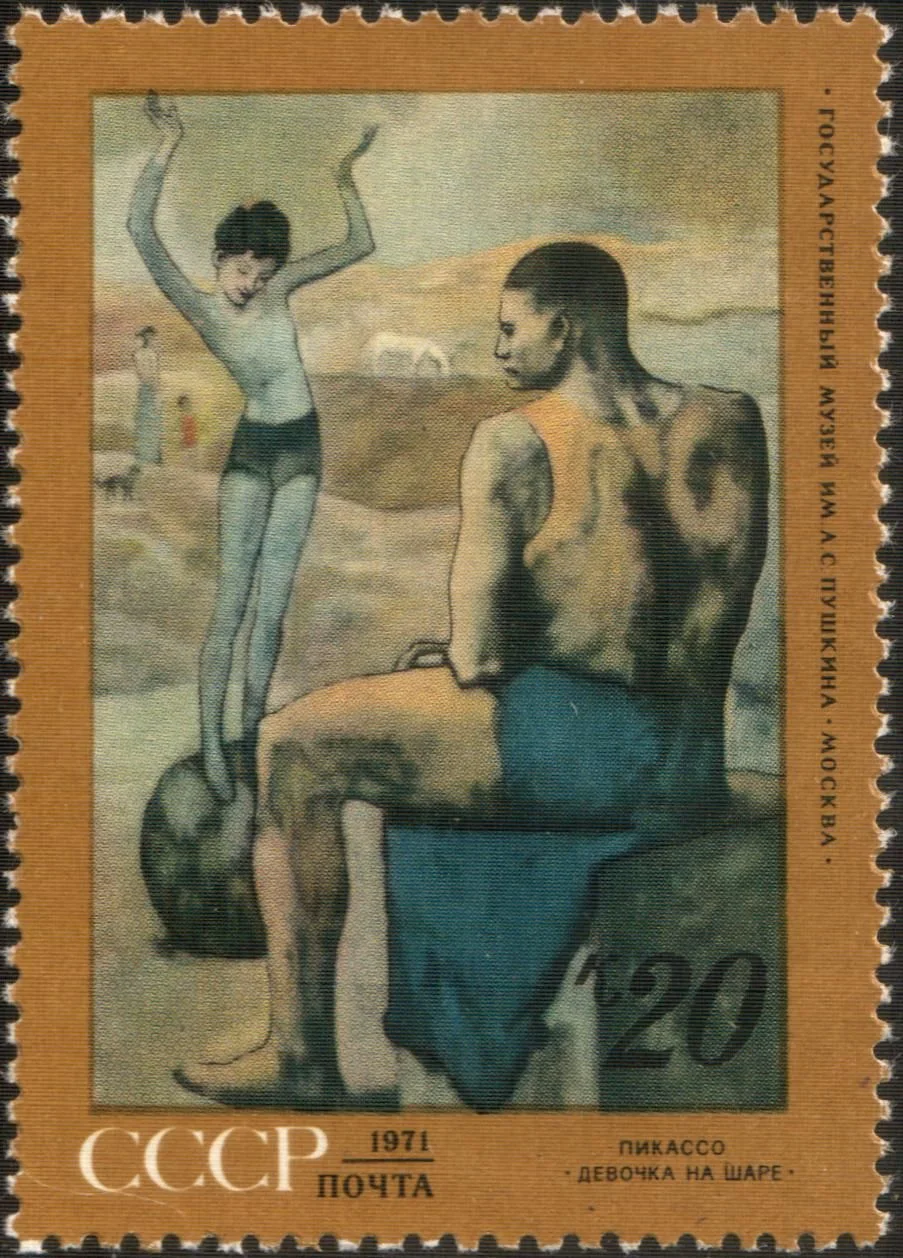
In October 1956, during the Thaw, Ilya Ehrenburg secured a Picasso exhibition for the artist’s seventy-fifth birthday. The girl on the ball hung right in the centre as the least controversial work: the early, humane Picasso was understandable and acceptable even to officials. As Leonid Parfyonov retells it, Ehrenburg calmed the crowd at the door: you waited twenty-five years for this exhibition, now wait calmly another twenty-five minutes. And in 1971 the painting appeared on a Soviet postage stamp and on the poster of the exhibition Picasso in Soviet Museums in Paris, returning for the first time to the city where it was painted.
).jpg)
A girl on the earthly ball
In Russia this painting has long had a life of its own. There is Viktor Dragunsky’s story The Girl on the Ball from the Deniska Stories and a 1966 film, though we found no direct link between the story and Picasso. In 1967 Yevgeny Yevtushenko wrote the line ‘like a girl on the earthly ball’. In 2012 the Bank of Russia struck the painting on a silver coin for the Pushkin Museum’s centenary, and Kamila Valieva skated two seasons running with a short programme inspired by the painting.
The painting itself has travelled too. In 2011 it was shown at the Prado in Madrid, in 2018 at the Musée d’Orsay in Paris, and in 2021–22 at the Fondation Louis Vuitton in the Morozov collection exhibition, seen by more than 1.2 million people. By spring 2022 planes no longer flew to Russia, and the paintings went home by truck in fifteen convoys, through Belgium, Germany and by ferry via Finland. By May every work was back in its museum.


Picasso himself, as far as we could find, said nothing about this painting. He disliked explaining his work and once said that variation does not mean evolution: if an artist changes his manner, it means his way of thinking has changed. A couple of years after the girl on the ball he would paint Les Demoiselles d’Avignon and never return to these quiet pink acrobats.
And they remained on the canvas, two people on empty ground: he on the cube, she on the ball. For a hundred and twenty years she has kept her balance, and for a hundred and twenty years he has watched her.